Burst pipe repairs in Eastgardens 2036
Eastgardens homes are relatively young, mostly built from the late 1980s onwards, so you might not expect burst pipes. But 30-odd years is long enough for copper laid against concrete to corrode, for the original braided hoses under every sink to perish, and for the fittings at a continuous flow unit on an outside wall to give way. In a slab home or a townhouse there's no crawl space for water to drain into, so a burst goes straight across the floor, into the wall or through to the neighbours. Here's what to do and how we fix it.
Stop the water first
- Find your stop tap. In houses it's beside the meter, usually near the front boundary. In townhouse complexes, meters are often grouped near the entrance or driveway; yours should be labelled with your unit number.
- In an apartment, look for an isolation valve in your unit, often in the laundry, kitchen cupboard or near the hot water. If there isn't one, contact your building manager.
- Turn off the hot water if hot water is escaping. Most Eastgardens homes have continuous flow gas units; turn the cold isolation valve under the unit off and switch the unit off at the power point.
- Keep water away from power and turn off circuits near the water.
- Drain the pipes by opening a low cold tap.
- Photograph the damage and call us.
If the stop tap won't turn, don't force it. If water is pouring from the meter or the street side, call Sydney Water. See our water shut-off guide.
How a burst shows up
- Water spraying from under a sink, behind a toilet or at the washing machine.
- Water across the floor from a wall or the base of a cupboard.
- Water dripping from a ceiling below a bathroom.
- Water pouring from under a continuous flow unit outside.
- A sudden drop in pressure at every tap.
- A wet patch on the front lawn, or none at all because the sand drains it away.
Why pipes burst in Eastgardens homes
Braided hoses at the end of their life
Almost every tap and toilet in an Eastgardens home is connected by a braided flexible hose. Many are original or second-generation, and hoses have a limited life. Rust spots, fraying, kinks or a bulge mean it's due. A failed hose runs at full mains pressure, which is why it's the most common indoor flood we see in this suburb. See flexi hose replacement.
Copper in slabs and walls
Copper laid in or under a slab when the house was built can corrode where it touches concrete or wears through a slab penetration without a sleeve. In walls, pipes can be damaged by later work: a screw for a TV bracket or a shelf through a pipe is more common than you'd think.
Fittings at the hot water unit
Continuous flow units on outside walls have hot and cold connections, a valve and sometimes a pressure relief device, all exposed to the weather. Fittings loosen and corrode, and an older unit can develop an internal leak that pours from the base.
Water services in sand
The pipe from the meter to the house runs under the front garden or driveway in sandy ground. If the sand under it settles or washes away, the pipe can crack, and a burst there may drain away without showing on the surface.
Pressure and water hammer
High mains pressure, and the sudden stop when a washing machine or dishwasher valve closes, strains every fitting. A pressure limiting valve at the meter helps. See water hammer.
Building work
New fences, pergolas, landscaping and extensions in established Eastgardens yards mean post-hole diggers and excavators near water services. If pressure drops while work is happening, check the meter.
Eastgardens homes and where bursts happen
| Home type | Common burst points | What we look for |
|---|---|---|
| Houses from the late 1980s and 1990s | Hoses, copper in slabs, the water service | Hose age, corrosion at slab penetrations |
| Townhouses | Hoses, pipes in shared walls, hot water units on walls | Damage reaching the neighbour, isolation |
| Apartments | Hoses, washing machine connections, pipes in walls | Water reaching the unit below |
| Courtyard homes | Garden tap risers and irrigation lines | Fittings in the sun, damaged buried lines |
| Older homes on the edges | Galvanised or older copper under timber floors | Rust and worn pipe |
How we repair a burst
- Make it safe: water off, power checked, floors protected.
- Find the damage with as little opening up as possible.
- Check the pipe around it for corrosion or wear.
- Give you options with a fixed price: repair in place, replace the section, or reroute.
- Repair it with approved pipe and fittings, properly clipped and protected.
- Restore the water, bleed the air, and check every tap and the hot water.
- Read the meter with everything off to rule out a second leak.
Hose replacement
Failed braided hoses replaced, and the rest checked while we're there.
Slab and wall bursts
Bursts in slabs and walls repaired or rerouted through walls and ceilings.
Hot water unit fittings
Burst fittings and valves at continuous flow units replaced.
Water service repairs
Bursts between the meter and the house found and repaired.
Garden and irrigation
Snapped garden taps, risers and burst irrigation lines repaired.
Isolation valves
Valves fitted so one fixture or one home can be turned off on its own.
Repair in place or reroute?
| What we find | Repair in place | Reroute |
|---|---|---|
| Burst hose | Replace the hose | Not needed |
| Copper burst in a wall cavity | Open a small section and repair | Rarely needed |
| Copper burst in the slab | If it can be reached under one or two tiles | Often better through the wall or ceiling |
| Water service burst in the yard | Repair the section | A new service if it's leaked before |
| Fitting at the hot water unit | Replace the fitting | Not needed |
What affects the cost
- Where the burst is: under a sink, in a wall, in a slab or in the yard.
- Finishes: tiles, timber floors and stone benchtops.
- Repair or reroute.
- Extras: new hoses throughout, isolation valves, a pressure limiting valve.
- Making good afterwards.
You get a fixed price for each option before any repair starts.
Who's responsible?
- Sydney Water: the main and the meter.
- You: pipes on the house side of the meter, including the water service.
- Townhouses and apartments: pipes inside your home are usually yours; shared pipes and common property are usually the owners corporation's. Damage to a neighbour's home is usually a matter for the owners and their insurers.
- Contractors: if building work damaged your pipe, the cost may be theirs.
Signs it's urgent and when it can wait
- Call straight away if water is coming through a ceiling, near electrics, flooding a room, or won't turn off.
- Call soon if the water is off and you need it back, or there's a steady drip.
- Book a time if hoses are rusty or frayed, or a fitting is weeping.
A recent burst repair nearby
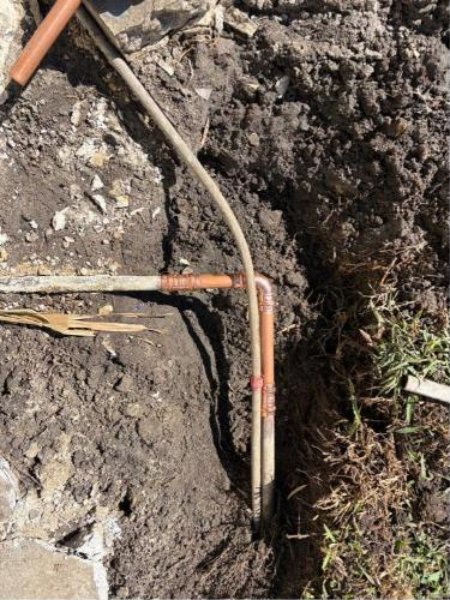
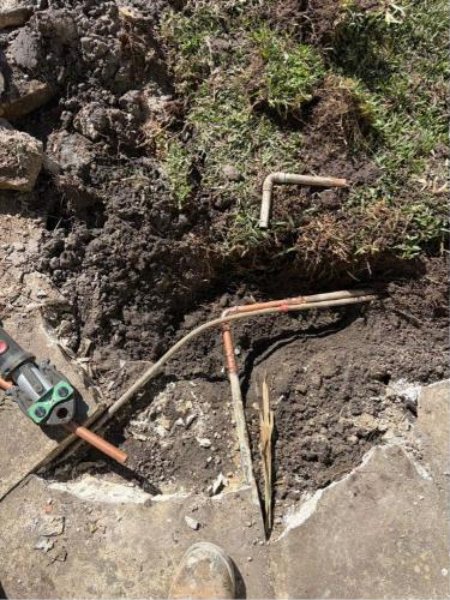
Here's a recent burst repair nearby in Matraville.
Buried copper service damaged by a crane, Matraville (nearby)
The problem: while a pool was being craned into the property next door, the copper water service under a Matraville backyard was damaged.
What we did: the pipe was already dug out and the water off when we arrived. Only the stretch under the lawn beside the paving was damaged and the rest of the copper was sound, so we cut out the damaged length and joined in new copper and fittings.
The result: the water was back on in under an hour, every tap ran properly, and the rest of the service didn't need replacing.
More local work is on our recent projects page.
“Great plumber, fixed my leaking taps quickly and at a great price!”
Tom (Google review)
Bursts across Eastgardens, area by area
- Around Westfield and Wentworth Avenue: apartments where bursts reach the unit below.
- Near Bunnerong Road: houses and townhouses with original hoses and copper in slabs.
- Around Mutch Park: family homes with garden taps and irrigation.
- Townhouse complexes: grouped meters and shared walls.
- The Pagewood and Hillsdale edges: older homes with older pipe.
Replace all the hoses at once
If one braided hose in your home has burst, the others are usually the same age. Replacing every hose under every sink, basin and toilet in one visit costs far less than repairing flood damage, and it means you won't be caught out by the next one. We check each isolating valve at the same time and replace any that are seized, so every fixture can be turned off on its own in future.
Bursts in townhouses and apartments
When a pipe bursts in a townhouse or apartment, water goes sideways into the neighbour's wall or down through the ceiling. Turn your water off as quickly as you can, tell the neighbour, and contact the building manager if there is one. Once we've repaired the burst, we can give you a written report with photos for the owners corporation and insurers. If the burst is in a shared pipe or common property, we'll tell you so.
Continuous flow units: when the burst is the unit
If water is pouring from inside a continuous flow unit, the heat exchanger or an internal fitting has usually failed. Turn the cold isolation valve under the unit off and switch the unit off. On an older unit, an internal leak usually means replacement rather than repair. We'll check and tell you honestly. See hot water in Eastgardens.
Rerouting in slab homes
When a pipe bursts in an Eastgardens slab, digging up tiled floors is often the most disruptive option. Rerouting abandons the burst section, caps it at each end, and runs a new pipe through the walls or ceiling space to the same fixture. It usually means less mess, no tile matching, and a pipe that can be reached easily in future. We'll price both approaches so you can decide.
Drying out
Slab homes don't have a subfloor to dry out, but water soaks into skirting boards, the bottom of plasterboard walls, cupboards and floor coverings. Lift rugs and underlay, open windows, run fans and pull cupboard kickboards off so air can get underneath. Swollen skirting and stained plasterboard may need replacing once dry. Keep an eye out for musty smells or mould over the next few weeks. Our written report helps with insurance.
Going away?
Before a trip, turn the water off at your stop tap or isolation valve and switch the hot water off. If that's not practical, at least turn off the washing machine taps so the hoses aren't under pressure while the house is empty. In an apartment, tell your building manager you'll be away.
A pipe check to do twice a year
- Look under every sink, basin and toilet at the braided hoses for rust, fraying or bulges.
- Turn each isolating valve off and on so it doesn't seize.
- Check under and around the continuous flow unit outside for drips.
- With everything off, read your meter, wait an hour and read it again.
- Check garden taps and irrigation for leaks.
Burst pipe words explained
- Braided hose: the flexible hose connecting a tap or toilet to the pipe.
- Isolating valve: a small valve that turns off water to one fixture.
- Stop tap: the valve at the meter that turns off water to the home.
- Water service: the pipe from the meter to the house.
- Reroute: running a new pipe a different way instead of repairing the old one in place.
- Continuous flow unit: a gas hot water unit that heats water as it's used.
Screws and nails through pipes
One of the more common causes of a sudden leak in an Eastgardens home has nothing to do with age. Someone hangs a TV, fits a shelf, installs a new kitchen cabinet or a towel rail, and a screw goes straight through a copper or plastic pipe in the wall. Sometimes it leaks straight away; sometimes the screw seals the hole for weeks before corrosion lets go. If damp appears on a wall after work has been done on it, a pierced pipe is a strong suspect. Before drilling into a wall near a kitchen, bathroom or laundry, a pipe and cable detector is a cheap tool that saves a lot of trouble.
Washing machine and dishwasher connections
The hoses that feed washing machines and dishwashers are under mains pressure whenever their taps are on, and in most homes that's all the time. Washing machine hoses in particular get pushed, bent and kinked every time the machine is moved. Replace them every few years, use quarter-turn taps you can turn off easily, and turn them off when you go away. A dishwasher connection under the sink should be checked whenever you're in that cupboard.
Garden taps and irrigation
Courtyard and garden taps in Eastgardens are often on short risers fixed to a wall or post. When a hose is pulled hard, the riser can crack at its base. Irrigation fittings and poly pipe crack in the sun or get speared by garden tools. These are usually smaller bursts, but they can waste a lot of water unseen. An isolation valve on the garden line means you can turn the garden off without cutting water to the house.
Pipe materials in Eastgardens homes
- Copper: the main water pipe in most homes from the late 1980s and 1990s.
- Cross-linked plastic and multilayer pipe: common in newer homes and updated kitchens and bathrooms.
- Polyethylene: often used for the water service from the meter.
- Galvanised steel: only in some older homes on the edges of the suburb.
We use whichever approved pipe suits the repair and where it's going, and join it properly to what's already there.
Questions to ask before a burst repair
- Are you licensed? Our licence is 398171C.
- Is the price fixed?
- Will you check the pipe around the burst and the other hoses?
- Would rerouting cause less damage than repairing in place?
- What warranty comes with the work? Ours is a lifetime labour warranty.
Label your meter in a complex
In a townhouse complex with a bank of meters, the worst time to find out which one is yours is when water is pouring across your kitchen floor. Take a minute now: turn on a tap in your home and watch which meter's dial moves. Mark it clearly, and show everyone in the house where it is and how to turn it. If the meter bank is behind a locked door, find out who has the key. We're happy to label it when we're there.
After the burst: checking the rest
Once the burst is fixed and the water's back on, we don't just pack up. We read the meter with every tap off to make sure there isn't a second leak, look at the other hoses and isolating valves in the home, and check the pressure at the meter. If pressure is high, a pressure limiting valve takes the strain off every fitting. If other hoses are rusty or kinked, we'll tell you. You decide what to do about any of it, with a fixed price for each item.
Bursts in the roof space
Some Eastgardens two-storey homes and townhouses have hot or cold pipes running through the ceiling space to an upstairs bathroom. A burst there shows up as a bulging or dripping ceiling. Turn the water off, keep away from any light fittings near the wet area, and put a bucket under the drip. If the ceiling is bulging with water, don't push on it. We'll locate the burst through the manhole or a small access hole and repair it.
Why Eastgardens homes are reaching this age
When a suburb is built over a short period, its homes tend to age together. Many Eastgardens houses and townhouses went up within a decade or so of Westfield opening in 1987. That means the original hoses, hot water units, tapware and shower waterproofing across whole streets are reaching the end of their lives at roughly the same time. If your neighbours have had hoses burst or hot water units replaced, it's a fair sign yours are at the same stage. Replacing hoses and checking fittings before they fail is one of the cheapest ways to avoid a flood.
Water services under driveways
In many Eastgardens homes the water service from the meter runs under the concrete driveway to the house. If it bursts there, water may appear at the edge of the driveway, bubble through a crack, or simply disappear into the sand. Breaking up the driveway to reach it is rarely the best answer. Often a new service can be run a different way, alongside the driveway under the garden edge, and the old one abandoned. We'll show you the options.
What happens when you call
Tell us what's going on
Call or send a quick form. A photo of the problem helps us come prepared. No call-out fee.
Options and a fixed price first
We find the cause, explain your options and give you a fixed price for each before any work starts.
Fixed, tested and backed
We do the work, test it, clean up, and back our workmanship with a lifetime labour warranty.
Why Eastgardens homeowners call us
- Based in Matraville, a few minutes from Eastgardens
- Rated 5.0 from 110 Google reviews
- Free quotes, with options and a fixed price before any work starts
- Lifetime labour warranty on our workmanship
- Licensed plumbers, drainers and gasfitters (Lic. 398171C)
Burst pipe questions from Eastgardens homeowners
Where's my stop tap in a townhouse complex?
Usually at a bank of meters near the entrance or driveway, labelled with unit numbers. Some homes also have an isolation valve inside.
I'm in an apartment. How do I turn the water off?
Look for an isolation valve in your unit. If there isn't one, contact your building manager.
Why did my braided hose burst?
Hoses have a limited life. Age, rust and kinks weaken them until they fail under mains pressure.
Should I replace all my hoses?
If one has burst, the others are usually the same age. Replacing them all at once is good value.
Can you repair a burst in my slab without breaking the floor?
Often, yes, by rerouting the pipe through the walls or ceiling.
Water is pouring from my hot water unit. What do I do?
Turn the cold isolation valve under it off and switch the unit off, then call us.
Is a burst at the meter mine?
No. The meter and street side are Sydney Water's.
My burst flooded the neighbour's home. What now?
Turn your water off, tell them and the building manager, and call us. Our report helps with insurance.
How long does a burst repair take?
A hose is minutes. A pipe in a wall or slab, or a water service, takes longer.
Will insurance cover it?
Many policies cover damage from a sudden burst. We can provide a written report.
Do you check for other leaks?
Yes. We read the meter with everything off before we leave.
Can high pressure cause bursts?
It adds strain. A pressure limiting valve at the meter protects the whole system.
More plumbing in Eastgardens: our Eastgardens plumber page, leak detection, hot water, taps and toilets and blocked drains. Nearby: burst pipes in Pagewood and Botany. Guides: flexi hose replacement, hidden water leaks and water meter guide.