Hot water repairs and replacement in Matraville 2036
In Matraville, the hot water system you have usually depends on the age of your home. Many of the post-war brick and fibro homes still run a gas or electric storage tank down the side of the house or in the laundry, often on its second or third replacement and sometimes without a tempering valve. The duplexes and townhouses that have replaced some of the original homes usually have gas continuous flow on an outside wall. Our workshop is on Girawah Place, so we're often just a few streets away.
Hot water problems we fix
No hot water
Faulty elements, thermostats, igniters and gas valves diagnosed and repaired.
Lukewarm or running out
Failing elements, sediment, thermostat faults or an undersized system sorted.
Leaking systems
Leaking tanks, valves and fittings repaired, or the system replaced.
Continuous flow faults
Error codes, ignition and flow faults on gas units fixed.
Replacement
Old systems replaced with one that fits the space and your household.
Tempering valves
Valves fitted or replaced so bathroom water is a safe temperature.
Signs your hot water needs attention
- No hot water at any tap.
- Water runs out faster than it used to.
- Lukewarm water even with the system on.
- Water around the base of the tank.
- The relief valve drips constantly or discharges a lot.
- Brown or rusty hot water.
- Rumbling or popping from the tank.
- An error code on a continuous flow unit.
Hot water in Matraville homes
Older cottages
Matraville's post-war brick and fibro homes were mostly built in the 1950s and 60s, and many still have an electric storage tank in the laundry, under the house or outside against a wall. Tanks last roughly 10 to 15 years, and we regularly find ones in Matraville that are well past that. Signs they're near the end include rust at the base, a dripping relief valve, brown water and the hot water running out sooner than it used to.
New family homes
Much of Matraville's original housing has been replaced with larger, taller family homes, often with three or four bathrooms. These usually have gas continuous flow units on an outside wall, sometimes two units linked together, or a large gas or electric storage tank. With several showers running at once, the system needs to be sized for peak demand, and the gas supply needs to be big enough.
Townhouses and duplexes
Many Matraville streets now have townhouses and duplexes. Each home usually has its own system, often continuous flow on a wall or a storage tank in a garage or courtyard. Space is tight, so replacements need to fit the same spot.
Units in the older walk-ups
Matraville's older two- and three-storey walk-ups usually have an electric storage tank inside each unit, often in a cupboard or the laundry. Replacing one means carrying the old tank out and the new one in, sometimes up several flights of stairs, and fitting it into the same space.
Matraville homes and their hot water
| Home type | Typical system | Common problems |
|---|---|---|
| Older cottages | Electric storage tank, sometimes gas storage | Old tanks leaking, rusting or running out |
| New family homes | Gas continuous flow or large storage | Error codes, gas supply, multiple showers at once |
| Townhouses and duplexes | Continuous flow or storage in a garage or courtyard | Tight spaces, ageing units |
| 1960s unit blocks | Electric storage in a cupboard | Old tanks, access, small capacity |
Repair or replace?
| Situation | Usually a repair | Usually a replacement |
|---|---|---|
| Electric tank with no hot water, under 10 years | New element or thermostat | Not usually |
| Tank leaking from the body | Not repairable | Replace |
| Relief valve dripping | New valve, or check pressure | Not usually |
| Continuous flow error code | Repair the fault | Replace if very old and parts scarce |
| Tank over 12 to 15 years with problems | Short-term repair possible | Usually replace |
| Hot water running out in a bigger home | Not usually | A larger or different system |
How we handle a hot water job
- Ask what's happening and what system you have.
- Check the system: power or gas, elements, thermostat, valves, error codes.
- Find the fault and check the system's age and condition.
- Give you options: repair, or replace with systems that suit, each with a fixed price.
- Do the work, safely and to the plumbing and gas standards.
- Test it and check the temperature at the taps.
What affects the cost
- The type of system and its size.
- Repair or replace.
- Access: stairs, tight cupboards, under-house spaces.
- Changes needed: gas supply, electrics, pipe sizes or location.
- Removal of the old system.
You get a fixed price for each option before any work starts.
Who's responsible?
- You: the hot water system in your home and its pipes and valves.
- Owners corporation: shared hot water systems, where a block has one.
- Your gas or electricity provider: the supply up to the meter.
Quick checks you can do
- Electric: check the hot water circuit breaker at the switchboard, and whether you're on an off-peak tariff.
- Gas storage: check whether the pilot light is on.
- Continuous flow: check the controller for an error code, and that the gas is on at the meter.
- Look around the base of the tank for water.
- Check the relief valve drain for constant dripping.
Signs it's urgent and when it can wait
- Call straight away if the tank is leaking heavily, there's a gas smell, or there's water near electrics.
- Call soon if there's no hot water at all, or the relief valve is discharging a lot.
- Book a time if the water runs out sooner than it should, or the tank is old and you'd like to plan a replacement.
A recent hot water job nearby
Here's a recent hot water replacement nearby in Maroubra, just across Heffron Park from Matraville.
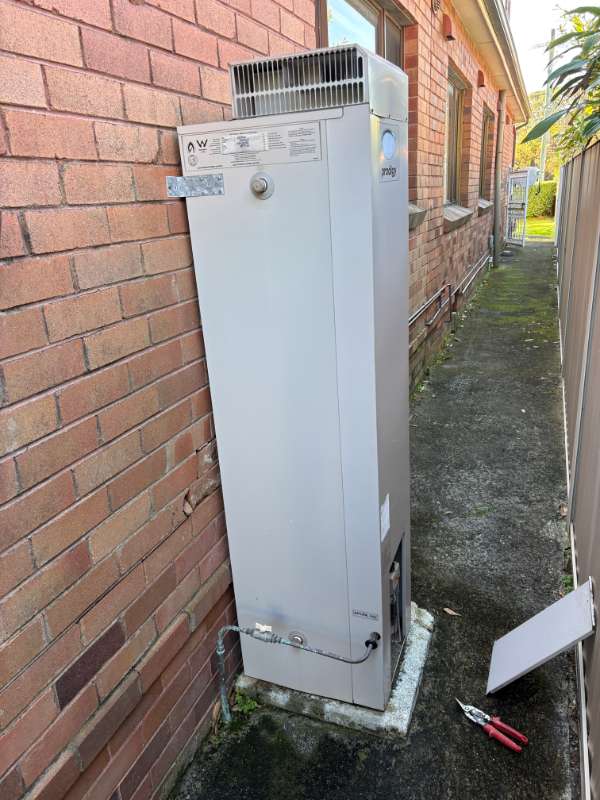
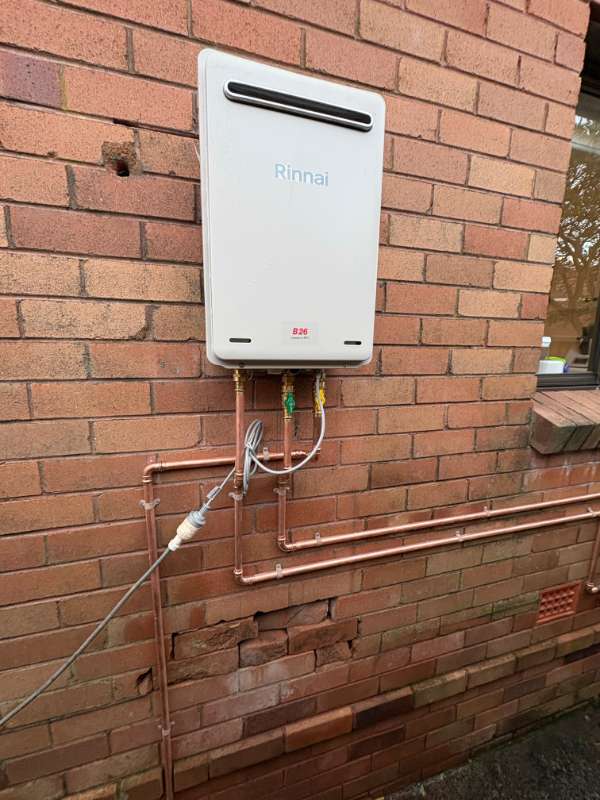
Old gas tank replaced with continuous flow, Maroubra (nearby)
The problem: the gas storage tank down the side of a Maroubra home had stopped sending hot water to the taps.
What we did: we explained repair against replacement and the systems that would suit, and the owners chose a Rinnai continuous flow unit. We removed the old tank, mounted the new unit on the wall, upsized the copper pipework, and replaced the gas regulator at the meter so the new system gets enough gas.
The result: reliable hot water at every tap, on a gas supply sized for the new unit.
“Great plumber, fixed my leaking taps quickly and at a great price!”
Tom (Google review)
More local work is on our recent projects page.
Hot water across Matraville
- Around Bunnerong Road and Franklin Street: post-war homes with storage tanks down the side passage.
- Off Australia Avenue: extended homes where the hot water now has to reach a new bathroom at the back.
- Near Heffron Park: family homes, some switching from electric to gas or a heat pump.
- Rebuilt blocks: duplexes and townhouses with continuous flow units on an outside wall.
- The older walk-ups: small electric tanks in cupboards and laundries.
Hot water system comparison
| System | Good points | Things to consider |
|---|---|---|
| Electric storage | Simple, works anywhere with power, can use off-peak | Higher running costs on peak power, takes space, can run out |
| Gas storage | Fast recovery, good for bigger households | Needs gas and a flue clearance, takes space |
| Gas continuous flow | Never runs out, compact, wall-mounted | Needs a large enough gas supply, flow limits with many showers |
| Heat pump | Very efficient, uses less power | Higher upfront cost, needs outdoor space and airflow, some noise |
Hot water for large family homes
Matraville has a larger share of families with children than many nearby suburbs, and the newer homes are often built with several bathrooms. When two or three showers run at once, plus a dishwasher or washing machine, a single small system can struggle. Signs include water going cold or lukewarm when someone else turns on a tap, or pressure dropping in the shower. Solutions include a larger continuous flow unit, two units linked together, or a larger storage tank. The gas meter and pipe size also need to be checked, as an undersized gas supply is a common reason continuous flow units underperform. We'll work out how much hot water your household uses at peak times and recommend a system to match.
Old electric tanks in older homes
If your Matraville cottage has an electric tank that's been there as long as you can remember, it's worth planning a replacement before it fails. Old tanks usually fail by leaking, sometimes slowly and sometimes all at once. A tank in a laundry or under the house can leak for a long time before anyone notices, damaging floors and framing. Replacing it on your schedule, rather than in a rush when it fails, means you can choose the best system for your home, compare options and avoid cold showers while you wait.
Continuous flow error codes
Gas continuous flow units show an error code on the controller or the unit itself when something is wrong. Common causes include ignition faults, a blocked flue or air intake, low gas pressure, a faulty flow sensor, or the unit overheating. Some codes are simple to fix, such as resetting the unit or checking the gas is on. Others need a licensed gasfitter. Note the code and the brand when you call, as it helps us bring the right parts. See gas hot water.
Older installs and tempering valves
In older Matraville homes we often find tanks without a tempering valve, or old copper and galvanised pipework around the unit that's due for an upgrade. When we install a new system, it's fitted to current standards, including a tempering valve to limit bathroom hot water to a safe temperature, and you get the compliance paperwork for the work we do. Heat pumps suit a lot of Matraville homes with room outside for the unit; we check the space, airflow and noise for your neighbours before recommending one. More in our heat pump guide.
The relief valve
Every storage hot water system has a temperature and pressure relief valve near the top of the tank. It releases water if the temperature or pressure inside gets too high, which is a safety feature. A small drip while the tank heats is normal. Constant dripping or a steady flow can mean the valve is worn, the water pressure is too high, or the tank is overheating. The valve should be eased (lifted gently) every six months to keep it working. See relief valve dripping.
Tempering valves and safe water
Hot water is stored at high temperatures to stop bacteria growing, but water that hot can scald in seconds. A tempering valve mixes in cold water so the water reaching bathroom taps is at a safe temperature. They're required on new and replacement systems that serve bathrooms. In a family home with young children, it's an important safety feature. See tempering valves.
Brown or rusty hot water
Brown hot water usually means the inside of the tank is rusting, especially if the cold water is clear. That's often a sign the tank is near the end of its life. In older Matraville homes, old galvanised pipes can also cause discoloured water at both hot and cold taps. We'll check which it is. See brown hot water.
Heat pumps
A heat pump works like a reverse air conditioner, taking heat from the air to heat the water. It uses much less electricity than a standard electric tank. Heat pumps suit Matraville homes with outdoor space for the unit and good airflow around it. They make a low hum when running, so placement away from bedroom windows is worth thinking about. We'll tell you honestly whether a heat pump suits your home and household.
Sizing a new system
Getting the size right matters more than the brand. A system that's too small runs out or goes lukewarm when it's needed most. One that's too big costs more to buy and, with storage tanks, more to keep hot. We ask how many people live in the home, how many bathrooms there are, whether showers run at the same time, and whether there's a bath, dishwasher or washing machine on hot. For a storage tank, that tells us the capacity you need. For continuous flow, it tells us the flow rate the unit needs to deliver at peak times, and whether your gas meter and pipes can supply it.
Gas supply for continuous flow
Continuous flow units need a lot of gas for short periods. If the gas meter, regulator or pipe is too small, the unit can't reach full output, and you get lukewarm water or error codes when several taps are on. This is common when an old gas storage tank is replaced with continuous flow, or when a new cooktop or heater is added to an older gas line. In the Maroubra job above, we replaced the gas regulator at the meter and upsized the pipework so the new unit had enough gas. We check the gas supply before recommending a continuous flow unit, so it works properly from day one.
Moving a hot water system
Sometimes the old system is in an awkward spot: in a laundry that's being reorganised, under the house, or on a wall where a new deck or extension is going. A replacement is a good time to move it, but moving a system means extending water pipes, and for gas units, extending the gas line and checking flue clearances. For electric systems, the power supply may need moving by an electrician. We'll explain what's involved and give you a fixed price for each option, including leaving it where it is.
Hot water and your power bill
Water heating is one of the biggest energy costs in most homes. An old electric tank on a peak tariff is the most expensive way to heat water. Moving it to an off-peak tariff, replacing it with a heat pump, or switching to gas can all reduce running costs, depending on your home and household. A tempering valve and a sensible thermostat setting help too. We'll talk you through the running cost differences between systems, so you can weigh them against the upfront cost.
Questions to ask before replacing
- How old is the current system, and can it be repaired?
- What size do I need for my household?
- Is my gas supply big enough for continuous flow?
- Would a heat pump suit my home?
- Can the new system go in the same place?
- What warranty comes with the system and the installation?
Looking after your hot water
- Ease the relief valve every six months.
- Have storage tanks checked every few years, including the sacrificial anode.
- Keep the area around the system clear.
- Keep the flue and air intake of gas units clear.
- Note any change in how long hot water lasts.
- Plan a replacement when the tank gets to 10 to 12 years old.
What to expect on the day
We give you a time window and let you know when we're on the way. We check the system, find the fault and explain your options with a fixed price for each. Most repairs are done on the first visit. Replacements are often done on the first visit if the system is in stock, or booked for the next available time. We remove the old system, install the new one, test it and check the water temperature at the taps before we leave.
Signs your system is near the end
- Rust on the tank, especially at the base or around fittings.
- Water pooling under the tank.
- Brown or rusty hot water.
- Rumbling, popping or banging as it heats.
- Hot water running out sooner than it used to.
- Repeated repairs in the past year or two.
- Age: a storage tank over 12 to 15 years old.
If you're seeing two or three of these, it's worth getting a replacement price now, so you can choose calmly rather than in a hurry with no hot water.
Before you call
- Note the brand and model from the label on the system.
- Note any error code on a continuous flow unit.
- Check the switchboard for a tripped hot water circuit.
- Check the gas is on at the meter for gas systems.
- Take a photo of the system and where it sits.
- Tell us about access: stairs, gates, dogs and parking.
With that information, we can usually tell you the likely cause and bring the right parts or a suitable replacement on the first visit.
Why Matraville homeowners call us
We're a few minutes away in Matraville, so we can get to Matraville quickly. We're licensed plumbers and gasfitters, we carry common hot water parts in the van, and we give you honest advice on whether to repair or replace. You'll get options and a fixed price for each before any work starts, and our workmanship carries a lifetime labour warranty.
Hot water words explained
- Storage tank: a system that heats and stores water in a tank.
- Continuous flow: a system that heats water as it flows, without storing it.
- Element: the part that heats the water in an electric tank.
- Thermostat: controls the water temperature.
- Relief valve: releases water if temperature or pressure gets too high.
- Anode: a rod in the tank that corrodes instead of the tank.
- Tempering valve: mixes hot and cold water to a safe temperature for bathrooms.
What happens when you call
Tell us what's going on
Call or send a quick form. A photo of the problem helps us come prepared. No call-out fee.
Options and a fixed price first
We find the cause, explain your options and give you a fixed price for each before any work starts.
Fixed, tested and backed
We do the work, test it, clean up, and back our workmanship with a lifetime labour warranty.
Why Matraville homeowners call us
- Based in Matraville, our workshop is on Girawah Place in Matraville
- Rated 5.0 from 110 Google reviews
- Free quotes, with options and a fixed price before any work starts
- Lifetime labour warranty on our workmanship
- Licensed plumbers, drainers and gasfitters (Lic. 398171C)
Hot water questions from Matraville homeowners
How quickly can you get to me in Matraville?
Our office and warehouse are in Matraville, so local jobs are close by. Call us and we'll give you the earliest time we can get there.
Do you charge to quote on a new hot water system?
No. We'll come out, look at your current system and quote on site for free.
Can you replace my old electric tank with gas or a heat pump?
Usually, yes. Switching depends on whether you have gas connected, where the unit can go and your power supply. We'll check and explain what's involved.
My relief valve is dripping. Is that a problem?
A small drip while the tank heats can be normal. A steady stream or a valve that never stops isn't. We'll test it and replace the valve if it's faulty.
Do you take the old unit away?
Yes. We remove and dispose of the old system as part of the replacement.
How long do hot water systems last?
Storage tanks usually 10 to 15 years. Continuous flow units often longer.
My tank is leaking. Can it be repaired?
If the tank body is leaking, it needs replacing. Leaking valves can be repaired.
Why does my hot water run out?
A failing element, sediment, a faulty thermostat, or a system too small for the household.
Which system suits a large family home?
Usually a larger continuous flow unit, two linked units, or a larger tank.
What does an error code mean?
It points to a fault. Note the code and brand when you call.
Do I need a tempering valve?
Yes, on new and replacement systems that serve bathrooms.
Are heat pumps worth it?
They use much less electricity. We'll tell you if one suits your home.
More plumbing in Matraville: our Matraville plumber page, gas fitting, leak detection, blocked drains, taps and toilets and water filters. Nearby: hot water in Maroubra, Malabar and Hillsdale. Guides: hot water guide, hot water services and heat pump guide.