Hot water repairs and replacement in Randwick 2031
Randwick is one of Sydney's oldest suburbs, and its homes put hot water systems in some awkward places. Terraces squeeze a tank into the laundry, under the stairs or down a narrow side passage. Interwar flats tuck an electric tank into a cupboard. Big Federation houses often have a gas storage tank out the back, and newer homes and units around the Junction have continuous flow units on the wall. When the hot water stops, the space it's in shapes the options. We come up from Matraville, find the fault, and give you clear choices with a fixed price.
Hot water problems we fix
No hot water
Faulty elements, thermostats, igniters and gas valves diagnosed and repaired.
Lukewarm or running out
Failing elements, sediment, thermostat faults or an undersized system sorted.
Leaking systems
Leaking tanks, valves and fittings repaired, or the system replaced.
Continuous flow faults
Error codes, ignition and flow faults on gas units fixed.
Tight-space replacements
Compact tanks and wall units chosen to fit laundries, cupboards and passages.
Tempering valves
Valves fitted or replaced so bathroom water is a safe temperature.
Signs your hot water needs attention
- No hot water at any tap.
- Water runs out faster than it used to.
- Lukewarm water even with the system on.
- Water around the base of the tank, or in the cupboard.
- The relief valve drips constantly or discharges a lot.
- Brown or rusty hot water.
- Rumbling or popping from the tank.
- An error code on a continuous flow unit.
Hot water in Randwick homes
Terraces and semis
Victorian and Federation terraces were never built with a modern hot water system in mind. Tanks end up in the laundry, under the stairs, in a narrow side passage or on a small back verandah. When a tank in a tight spot fails, the replacement has to fit the same space and get in through the same door or gate. We measure first and suggest systems that fit.
Federation houses
Larger Federation homes often have a gas or electric storage tank outside at the back, sometimes with long pipe runs to bathrooms at the far end of the house. Hot water can take a while to arrive at distant taps, and older tanks can be undersized for a modern household.
Interwar flats
Randwick's interwar red-brick flats usually have an electric storage tank inside each unit, often in a cupboard or the laundry. They're small, and when they fail, they can leak into the cupboard and the floor below. Replacing one means carrying the old tank out and the new one in, often up stairs.
Newer homes and units
Homes and units around the Junction, the hospital and the university often have gas continuous flow on a wall or balcony, or a central system in a larger building.
Heritage streets
Parts of Randwick are heritage conservation areas. Where a new hot water unit would show from the street, we'll suggest a position that keeps it out of sight.
Randwick homes and their hot water
| Home type | Typical system | Common problems |
|---|---|---|
| Terraces and semis | Storage tank in a laundry, under stairs or in a side passage | Tight spaces, access, old tanks |
| Federation houses | Gas or electric storage out the back | Long pipe runs, undersized tanks |
| Interwar flats | Small electric tank in a cupboard | Leaks into the cupboard and below, stairs |
| Newer homes and units | Continuous flow on a wall or balcony | Error codes, flue position, gas supply |
Repair or replace?
| Situation | Usually a repair | Usually a replacement |
|---|---|---|
| Electric tank with no hot water, under 10 years | New element or thermostat | Not usually |
| Tank leaking from the body | Not repairable | Replace |
| Relief valve dripping | New valve, or check pressure | Not usually |
| Continuous flow error code | Repair the fault | Replace if very old and parts scarce |
| Tank over 12 to 15 years with problems | Short-term repair possible | Usually replace |
| Hot water running out | Sometimes a failing element | Often a larger or different system |
How we handle a hot water job
- Ask what's happening and what system you have, and where it is.
- Check the system: power or gas, elements, thermostat, valves, error codes.
- Find the fault and check the system's age and condition.
- Measure the space and the access if replacement is likely.
- Give you options: repair, or replace with systems that fit, each with a fixed price.
- Do the work, safely and to the plumbing and gas standards.
- Test it and check the temperature at the taps.
What affects the cost
- The type of system and its size.
- Repair or replace.
- Access: stairs, narrow passages, tight cupboards.
- Changes needed: gas supply, electrics, pipe sizes or location.
- Removal of the old system.
You get a fixed price for each option before any work starts.
Who's responsible?
- You: the hot water system in your home and its pipes and valves.
- Owners corporation: shared hot water systems, where a building has one.
- Your gas or electricity provider: the supply up to the meter.
Quick checks you can do
- Electric: check the hot water circuit breaker at the switchboard, and whether you're on an off-peak tariff.
- Gas storage: check whether the pilot light is on.
- Continuous flow: check the controller for an error code, and that the gas is on.
- Look around the base of the tank, or inside the cupboard, for water.
- Check the relief valve drain for constant dripping.
Signs it's urgent and when it can wait
- Call straight away if the tank is leaking heavily, there's a gas smell, or there's water near electrics.
- Call soon if there's no hot water at all, or the relief valve is discharging a lot.
- Book a time if the water runs out sooner than it should, or you'd like to plan a replacement.
A recent hot water job nearby
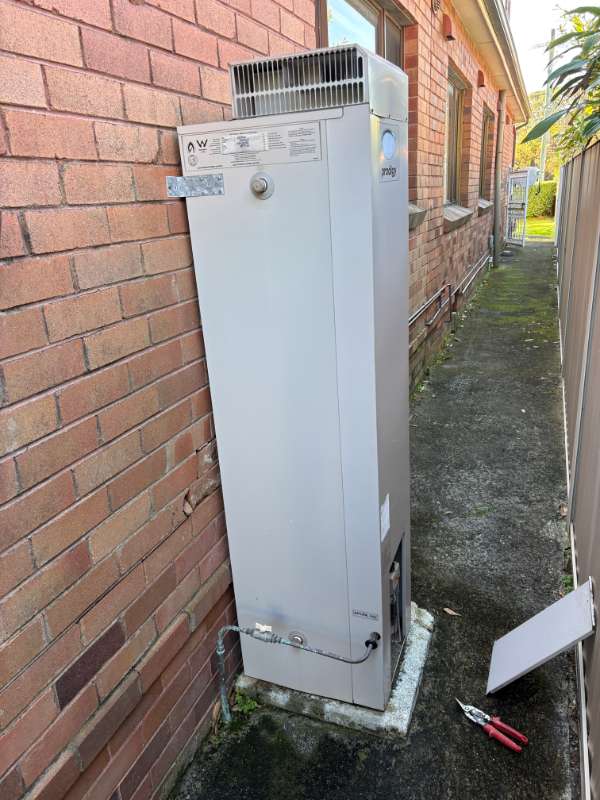
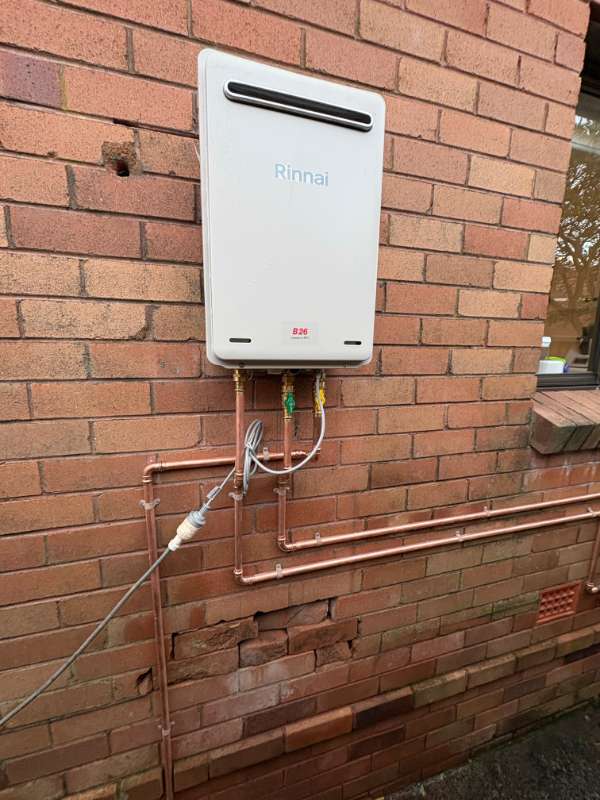
Here's a recent hot water replacement nearby in Maroubra, where an old gas tank down the side of the house was replaced.
Old gas tank replaced with continuous flow, Maroubra (nearby)
The problem: the gas storage tank down the side of a Maroubra home had stopped sending hot water to the taps.
What we did: we explained repair against replacement and the systems that would suit, and the owners chose a Rinnai continuous flow unit. We removed the old tank, mounted the new unit on the wall, upsized the copper pipework, and replaced the gas regulator at the meter so the new system gets enough gas.
The result: reliable hot water at every tap, on a gas supply sized for the new unit.
“Great plumber, fixed my leaking taps quickly and at a great price!”
Tom (Google review)
More local work is on our recent projects page.
Hot water across Randwick
- Around the Junction: units and newer homes with continuous flow and central systems.
- Near the hospital and university: a mix of flats, terraces and newer buildings.
- Towards Centennial Park and the racecourse: large Federation houses with long pipe runs.
- On the slopes towards Coogee and Clovelly: terraces and semis with tanks in tight spots.
- In the heritage conservation areas: homes where units need to stay out of sight from the street.
Replacing a tank in a tight space
In a Randwick terrace, the hot water tank might sit in a laundry barely wider than the tank itself, under a staircase, or in a side passage with a narrow gate. Before we recommend a replacement, we measure the space, the doorway or gate it has to come through, and the clearance needed around the new unit for valves and servicing. Options include a slimmer storage tank, a compact electric unit, or a gas continuous flow unit mounted on an outside wall, which frees up the space inside altogether. If a gas unit would be visible from a heritage street, we'll look for a wall that's out of sight.
On the day, we protect floors and walls on the way in and out, remove the old tank, fit the new system, connect it, and test it. Most like-for-like replacements are done in a few hours.
Long pipe runs in bigger houses
In a large Federation house, the hot water system might be at the back, with bathrooms at the far end or upstairs. Every time you turn on the hot tap, the cold water in the pipe has to run out before hot arrives, which wastes water and time. Options include insulating the hot water pipes, moving the system closer to the bathrooms, adding a second, smaller unit near the far bathroom, or fitting a recirculating system. We'll talk through which makes sense for your home and household.
Hot water in flats
In Randwick's interwar walk-ups, a small electric tank in a cupboard is common. When it starts leaking, water can run under the floor and into the ceiling of the flat below. If you see water in the cupboard, turn off the cold water valve at the tank and the hot water circuit at the switchboard, and call us. We'll replace the tank, carry the old one out, and check the floor and ceiling below for damage. If the building has a central hot water system, that's usually the owners corporation's responsibility, and we'll tell you straight away if that's where the problem is.
Continuous flow error codes
Gas continuous flow units show an error code when something is wrong. Common causes include ignition faults, a blocked flue or air intake, low gas pressure, a failed sensor or the unit overheating. Note the code and the brand when you call, as it helps us bring the right parts. See gas hot water.
Gas supply for continuous flow
Continuous flow units need a lot of gas for short periods. Older Randwick homes often have gas pipes sized for a stove and a small storage tank. If the meter, regulator or pipe is too small, the unit can't reach full output, and you get lukewarm water when several taps are on. In the Maroubra job above, we replaced the regulator and upsized the pipework so the new unit had enough gas. We check the supply before recommending continuous flow.
The relief valve
Every storage system has a temperature and pressure relief valve near the top of the tank. A small drip while heating is normal; constant dripping can mean the valve is worn, pressure is too high or the tank is overheating. Ease the lever gently every six months. See relief valve dripping.
Tempering valves and safe water
Hot water is stored hot to stop bacteria growing, but water that hot can scald in seconds. A tempering valve mixes in cold water so bathroom taps get water at a safe temperature. They're required on new and replacement systems that serve bathrooms. See tempering valves.
Brown or rusty hot water
Brown hot water usually means the inside of the tank is rusting, especially if the cold is clear. Old galvanised pipes, common in older Randwick houses, can also cause discoloured water at both hot and cold taps. We'll check which it is. See brown hot water.
Heat pumps
A heat pump takes heat from the air to heat the water, using much less electricity than a standard electric tank. It needs outdoor space with good airflow and makes a low hum, so placement away from bedroom windows, yours and the neighbours', matters on close-set Randwick streets. We'll tell you honestly whether one suits your home.
Hot water system comparison
| System | Good points | Things to consider in Randwick homes |
|---|---|---|
| Electric storage | Simple, works anywhere with power, can use off-peak | Takes space a terrace may not have, higher running costs on peak power |
| Gas storage | Fast recovery, good for bigger households | Needs gas, a flue clearance and outdoor space |
| Gas continuous flow | Never runs out, compact, wall-mounted, frees up indoor space | Needs enough gas supply, position matters in heritage streets |
| Heat pump | Very efficient, uses less power | Needs outdoor space and airflow, some noise on close-set streets |
Sizing a new system
Getting the size right matters more than the brand. We ask how many people live in the home, how many bathrooms there are, whether showers run at the same time, and whether there's a bath or dishwasher on hot. A shared house near the university has very different needs from a couple in a terrace. For continuous flow, we check the gas meter and pipes can supply the unit at full output.
Signs your system is near the end
- Rust on the tank, especially at the base or around fittings.
- Water pooling under the tank.
- Brown or rusty hot water.
- Rumbling, popping or banging as it heats.
- Hot water running out sooner than it used to.
- Repeated repairs in the past year or two.
- Age: a storage tank over 12 to 15 years old.
If you're seeing two or three of these, get a replacement price now so you can choose calmly, rather than in a hurry with no hot water.
Hot water and your power bill
Water heating is one of the biggest energy costs in most homes. An old electric tank on a peak tariff is the most expensive way to heat water. An off-peak tariff, a heat pump or gas can all reduce running costs, depending on your home. We'll talk you through the differences.
Before you call
- Note the brand and model from the label.
- Note any error code on a continuous flow unit.
- Check the switchboard for a tripped hot water circuit.
- Take a photo of the system, where it sits, and the doorway or gate to it.
- Tell us about access: stairs, parking and narrow passages.
With that information, we can usually tell you the likely cause and bring the right parts or a suitable replacement on the first visit.
Why Randwick homeowners call us
We come up from Matraville and look after hot water in Randwick terraces, Federation houses and flats every week. We know how tight the spaces can be, carry common parts in the van, and give you honest advice on whether to repair or replace. You'll get options and a fixed price for each before any work starts, and our workmanship carries a lifetime labour warranty.
Looking after your hot water
- Ease the relief valve every six months.
- Have storage tanks checked every few years, including the sacrificial anode.
- Keep the area around the system clear.
- Keep the flue and air intake of gas units clear.
- Note any change in how long hot water lasts.
- Plan a replacement when the tank gets to 10 to 12 years old.
What to expect on the day
We give you a time window and let you know when we're on the way. We check the system, find the fault and explain your options with a fixed price for each. Most repairs are done on the first visit. Replacements are often done on the first visit if the system is in stock and fits, or booked for the next available time.
Shared houses and student homes
With the hospital and university nearby, many Randwick homes are shared by several adults, each wanting a hot shower at the same time in the morning. A tank sized for a couple can run out quickly with four or five people. If the last person in the queue always gets a cold shower, the system may be undersized rather than faulty. A larger tank, a continuous flow unit with enough flow for two showers at once, or a second unit for a separate bathroom can fix it. We'll look at how the house is used and suggest the simplest change that solves it.
If you own the home and rent it out, we can work out a time that suits the people living there and keep the work as quick and tidy as possible.
Leaks from the hot water system
A leak at the hot water system is easy to miss when it's tucked under the stairs or in a side passage. Watch for water on the floor, rust stains, a damp cupboard or a relief valve drain that's always running. Hot water leaks waste both water and the energy used to heat it. If your bill has jumped, check the system first. See leak detection.
Hot water words explained
- Storage tank: a system that heats and stores water in a tank.
- Continuous flow: a system that heats water as it flows.
- Element: the part that heats the water in an electric tank.
- Relief valve: releases water if temperature or pressure gets too high.
- Anode: a rod in the tank that corrodes instead of the tank.
- Tempering valve: mixes hot and cold water to a safe temperature for bathrooms.
What happens when you call
Tell us what's going on
Call or send a quick form. A photo of the problem helps us come prepared. No call-out fee.
Options and a fixed price first
We find the cause, explain your options and give you a fixed price for each before any work starts.
Fixed, tested and backed
We do the work, test it, clean up, and back our workmanship with a lifetime labour warranty.
Why Randwick homeowners call us
- Based in Matraville, a short drive up from Matraville
- Rated 5.0 from 110 Google reviews
- Free quotes, with options and a fixed price before any work starts
- Lifetime labour warranty on our workmanship
- Licensed plumbers, drainers and gasfitters (Lic. 398171C)
Hot water questions from Randwick homeowners
How long do hot water systems last?
Storage tanks usually 10 to 15 years. Continuous flow units often longer.
My tank is in a tiny laundry. Can it be replaced?
Yes. We measure the space and access and suggest systems that fit.
My tank is leaking. Can it be repaired?
If the tank body is leaking, it needs replacing. Leaking valves can be repaired.
Why does my hot water run out?
A failing element, sediment, a faulty thermostat, or a system too small for the household.
Why does hot water take so long to reach my bathroom?
Long pipe runs in bigger houses. Options include a second unit near the bathroom.
Can you replace a tank in an upstairs flat?
Yes, including carrying it up the stairs.
What does an error code mean?
It points to a fault. Note the code and brand when you call.
Is a dripping relief valve normal?
A small drip while heating is normal. Constant dripping isn't.
Do I need a tempering valve?
Yes, on new and replacement systems that serve bathrooms.
I'm in a heritage area. Does that matter?
We'll suggest a position for any new unit that keeps it out of sight from the street.
How quickly can you replace a system?
Often on the first visit if the system is in stock.
What warranty do I get?
Our workmanship carries a lifetime labour warranty.
More plumbing in Randwick: our Randwick plumber page and blocked drains in Randwick. Nearby: hot water in Coogee, Kensington and Kingsford. Services: hot water, gas hot water and tempering valves. Guides: relief valve dripping, hot water running out and brown hot water.