Burst pipe repairs in Little Bay 2036
Little Bay is a coastal suburb, open to the Tasman Sea on one side, with the rocky shoreline running down to Henry Head and Botany Bay. That's wonderful for living and hard on outdoor plumbing. Salt carried on the breeze corrodes copper, brass and steel fittings outside, while inside, the post-war homes built on War Ballot blocks in the 1950s have water pipes that are now 70 years old. The newer homes on the former Prince Henry Hospital site have modern pipe, but bursts there go through slabs and ceilings. Here's what to do first and how we fix it.
Stop the water first
- Find your stop tap. On houses it's beside the meter near the front boundary. In townhouse complexes on the hospital site, meters may be grouped together and labelled by unit.
- In an apartment, look for an isolation valve inside your unit. If there isn't one, contact your building manager.
- Turn off the hot water: continuous flow units at the cold isolation valve and the power point, storage systems at the switchboard or gas control.
- Keep water away from power.
- Drain the pipes by opening a low cold tap.
- Photograph the damage, then call us.
If the stop tap is seized, don't force it. Stop taps near the coast often corrode solid. If water is coming from the meter or the street, call Sydney Water. See our water shut-off guide.
How a burst shows up
- A spray from an outside wall, often near the hot water or a garden tap.
- Water across a floor from under a sink, behind a toilet or at the washing machine.
- Water through a ceiling below a bathroom.
- A hiss under the floor of an older home.
- Pressure dropping at every tap.
- Water bubbling up through a crack in a path, or a soggy patch in the front garden.
Why pipes burst in Little Bay
Sea air on outdoor pipework
Little Bay's exposure to the ocean means salt settles on everything outside. Copper turns green, brass fittings pit, and clips rust and hold moisture against the pipe. The weak point is usually a fitting near the hot water system, a garden tap or an outdoor shower. Heavy green or white crust is a warning that the pipe is thinning. See green copper pipes.
Old pipe in War Ballot homes
Many of the homes built on War Ballot land in the 1950s still have some galvanised steel, which rusts from the inside, and early copper. Where later work joined copper to galvanised, the join corrodes faster. See our galvanised pipes guide.
Pipes in slabs on the hospital site
Homes built on the former Prince Henry Hospital site since the early 2000s are mostly on slabs, with copper or plastic pipe in the floor and walls. Bursts here are less common, but when a fitting fails, or a screw goes through a pipe during later work, water has nowhere to go but across the floor or into the home below.
Water services in rocky ground
Parts of Little Bay are rocky. Water services laid shallow over rock wear where they rest on a high point, and roots growing along the rock can press on them.
Hoses and fittings
Braided hoses under sinks and toilets have a limited life, and a failed hose runs at full mains pressure. See flexi hose replacement.
Pressure and water hammer
High mains pressure and the shock of fast-closing valves strain every fitting. A pressure limiting valve at the meter helps. See water hammer.
Little Bay homes and where bursts happen
| Home type | Common burst points | What we look for |
|---|---|---|
| Post-war War Ballot homes | Galvanised and old copper, outdoor pipework | Rust, pitting, joins between metals |
| Homes near the beach and headlands | Outdoor copper, garden taps, hot water fittings | Salt corrosion, seized valves |
| Houses on the hospital site | Pipes in slabs and walls, hoses | Fittings, pierced pipe, hose age |
| Townhouses | Shared walls, grouped meters | Water reaching the neighbour |
| Apartments | Hoses, washing machines, pipes in walls | Water reaching the unit below |
How we repair a burst
- Make it safe: water off, power checked, floors protected.
- Find and expose the damage with as little disturbance as possible.
- Check the pipe either side for corrosion and wear.
- Give you options with a fixed price: repair, replace the run, or reroute.
- Repair it with pipe and fittings suited to where they're going. Outside, that means fittings that stand up to salt air, clipped and protected.
- Restore the water, bleed the air and check every tap.
- Read the meter with everything off to rule out a second leak.
Outdoor pipe replacement
Corroded copper and fittings outside replaced and protected.
Galvanised replacement
Rusted galvanised pipe in older homes replaced in stages or all at once.
Slab and wall bursts
Bursts in newer homes repaired or rerouted through walls and ceilings.
Water service repairs
Bursts between the meter and the house repaired, including in rocky ground.
Hose replacement
Failed hoses replaced, and the others checked.
Stop tap replacement
Seized coastal stop taps replaced so you can turn the water off.
Repair or replace?
| What we find | Repair makes sense | Replacement makes sense |
|---|---|---|
| One split in sound copper | Join in new pipe | Rarely |
| Pitted outdoor copper near the coast | To get the water back on | The exposed run before it splits again |
| Galvanised that's burst | A short-term fix | The galvanised section or all of it |
| Burst in a slab | If reachable | Often a reroute |
| Service resting on rock | If local | Re-lay it properly bedded |
What affects the cost
- Where the burst is: outside wall, subfloor, slab or yard.
- Ground: rock takes longer to dig than sand.
- How much pipe needs replacing.
- Finishes in newer homes.
- Extras: stop taps, hoses, a pressure limiting valve.
- Making good.
You get a fixed price for each option before any repair starts.
Who's responsible?
- Sydney Water: the main and the meter.
- You: everything on the house side of the meter.
- Townhouses and apartments: pipes in your home are usually yours; shared pipes and common property are the owners corporation's.
- Contractors: if building work damaged your pipe, the cost may be theirs.
Signs it's urgent and when it can wait
- Call straight away if water is coming through a ceiling, near electrics, flooding a room, or won't turn off.
- Call soon if the water is off and you need it back.
- Book a time if outdoor copper is green and pitted, or a fitting is weeping.
A recent burst repair nearby
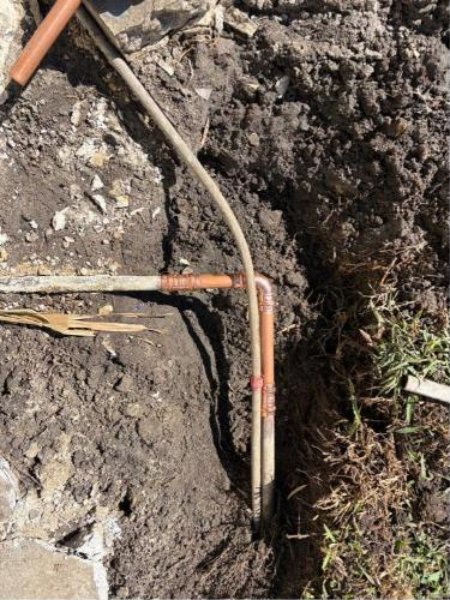
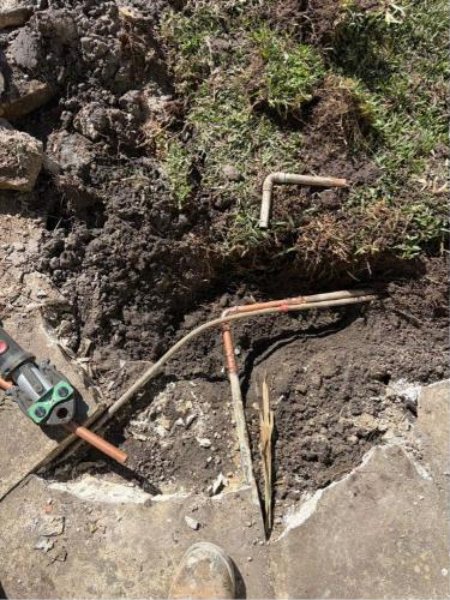
Here's a recent burst repair nearby in Matraville, just up the road from Little Bay.
Copper water service repaired after crane damage, Matraville (nearby)
The problem: a crane lifting a pool into the property next door damaged the buried copper water service in a Matraville backyard.
What we did: the line had been dug out and the water turned off before we arrived. Only the section under the lawn beside the paving was damaged and the rest of the copper was sound, so we cut out the damaged length and joined in new copper and fittings.
The result: the water was back on in under an hour, every tap ran properly, and the rest of the line didn't need replacing.
More local work is on our recent projects page.
“Great plumber, fixed my leaking taps quickly and at a great price!”
Tom (Google review)
Bursts across Little Bay, area by area
- The older streets on War Ballot blocks: galvanised and old copper, and outdoor pipework.
- Near Little Bay Beach and the rock pool: the strongest sea air on outdoor fittings.
- Towards Henry Head: exposed, rocky blocks.
- The former Prince Henry Hospital site: newer houses, townhouses and apartments with pipes in slabs.
- Around the golf courses: homes with long services and garden irrigation.
Outdoor showers and garden taps
Plenty of Little Bay homes have an outdoor shower for rinsing off after the beach. It's the most exposed plumbing on the property, with copper up an outside wall in full sea breeze and sand getting into the mixer. Every so often, check the pipe and fittings for crust and weeping. Rinse the mixer with fresh water, keep the pipe clipped firmly, and turn it on through winter so the valve doesn't seize. When we replace outdoor pipework, we use fittings suited to the coast.
Hot water units outside
Continuous flow units on the newer homes, and storage tanks on the older ones, usually sit outside where the sea air reaches them. The pipes and valves right at the unit carry hot water under pressure and expand and contract daily. Split fittings and corroded valves there are common. If water is spraying from the unit, turn off the cold isolation valve and the unit, then call us. See hot water in Little Bay.
Bursts in apartments
In Little Bay's apartment buildings, a burst goes straight down. Turn your isolation valve off, or ask the building manager to, and tell your neighbour below. Once we've fixed the burst, we can give you a written report with photos for the owners corporation and insurers.
Rerouting in slab homes
When a pipe bursts in a slab, rerouting is often better than breaking the floor. The burst section is capped, and a new pipe runs through walls or ceilings to the same fixture. It's usually quicker, less messy, and leaves the new pipe where it can be reached.
Drying out
In older homes with timber floors, clear the subfloor vents so air can move. In slab homes, lift rugs, open windows, run fans and pull off cupboard kickboards. Swollen skirting and stained plasterboard may need replacing once dry. Our written report helps with insurance.
Going away?
Before a trip, turn the water off at the stop tap and switch the hot water off. At the very least, turn off the washing machine taps. In an apartment, tell your building manager you'll be away.
A twice-yearly pipe check
- Walk around the house and look at every outdoor pipe and fitting for green crust, white powder or rust.
- Turn the stop tap a little each way so it doesn't seize, then open it fully.
- Check the braided hoses under every sink and toilet.
- With everything off, read the meter, wait an hour, read it again.
- Check the pipes and valves at the hot water unit.
Questions to ask before a burst repair
- Are you licensed? Our licence is 398171C.
- Is the price fixed?
- Will you check the pipe either side?
- What fittings will you use outside, given the sea air?
- What warranty comes with the work? We give a lifetime labour warranty.
Burst pipe words explained
- Water service: the pipe from the meter to the house.
- Stop tap: the valve at the meter that turns off water to the home.
- Pitting: small pits eaten into copper by corrosion.
- Galvanised pipe: old zinc-coated steel pipe that rusts from inside.
- Reroute: a new pipe run a different way instead of repairing the old one.
- Lagging: insulation or a cover fitted around exposed pipe.
Choosing fittings for the coast
Not all pipe fittings are equal outside in Little Bay's sea air. Bare brass and cheap chrome corrode quickly, and steel clips rust and stain the wall. When we repair or replace outdoor pipework here, we use fittings and clips suited to coastal conditions, keep pipe clipped firmly so it doesn't rub, and lag or cover exposed sections where it makes sense. A little extra care at installation adds years to the life of the pipe.
Pipes trapped under extensions
Some older Little Bay homes have been extended at the back, with the new slab poured over the original water pipe. When that pipe bursts, it's under concrete. If you know or suspect a line runs under an extension, it's worth having a new run installed around it through the wall or ceiling before it fails. If you're planning an extension, tell us before the slab goes in.
Screws through pipes
In the newer homes on the hospital site, a common cause of a sudden leak is a screw or nail through a pipe in the wall when a TV, shelf, towel rail or cabinet is fitted. It may leak at once or weeks later. If damp appears near where something has been fixed to a wall, a pierced pipe is a strong suspect. A pipe and cable detector before drilling saves a lot of trouble.
Replace all the hoses at once
If one braided hose has burst, the others in the home are probably the same age. Replacing every hose under every sink, basin and toilet in one visit costs far less than repairing flood damage. We check each isolating valve at the same time and replace any that are seized.
Garden irrigation
The bigger gardens on Little Bay's older blocks often have irrigation lines, garden taps and hose reels. Poly pipe cracks in the sun, fittings pop off, and garden forks spear buried lines. These leaks can run for months unseen, especially if irrigation runs early in the morning. If the meter test shows a leak, turn the irrigation off and test again.
After the burst: what we check
Once the water's back on, we read the meter with every tap off to make sure there's no second leak, look at the hoses and isolating valves in the home, and check the pressure at the meter. If outdoor pipework is badly corroded elsewhere, we'll tell you. You decide what to do with each item, with a fixed price for each.
Two eras of plumbing
| Older War Ballot homes | Newer hospital-site homes | |
|---|---|---|
| Water pipe | Galvanised and early copper | Copper and modern plastic |
| Common burst | Rusted galvanised, corroded outdoor copper | Hoses, fittings, pierced pipe |
| Where water goes | Under the timber floor into the sand | Across the slab or into the home below |
| Usual fix | Replace the corroded section or run | Repair the fitting or reroute |
Time to replace the old pipe?
If your older Little Bay home has had more than one burst, still has galvanised pipe, or has outdoor copper that's green and pitted along its length, it may be time to replace the water pipes rather than keep patching. It can be done in stages: the water service first, then the outdoor runs and the worst sections under the floor, then the rest when a kitchen or bathroom is next updated. We'll tell you what's there and give you a fixed price for each stage.
Brown water in older homes
Brown water first thing in the morning in an older Little Bay home is usually rust from galvanised pipe. It's also a sign that the pipe is thinning and more likely to burst. Running the cold tap for a minute clears it for the day, but replacing the galvanised sections is the long-term answer. If only the hot runs brown, the hot water system may be the source. See brown hot water.
Label your meter
In townhouse complexes on the old hospital site, meters are often in a bank. Find yours now: turn on a tap in your home and see which meter moves. Label it clearly and show everyone in the house. If the meter bank is behind a locked door, find out who has the key before you need it.
Pipes near the sand dunes and beach
Homes closest to Little Bay Beach have sandier ground. A water service in sand can lose its bedding if a small leak washes it out, and then sag and split. Because sand drains so well, a burst there may not show on the surface, and the first sign may be the bill. The meter test tells you quickly.
Why Little Bay's sea air is so hard on pipes
Little Bay faces the Tasman Sea, and the wind regularly carries fine salt spray inland. It settles on every outdoor surface and stays there between rain showers. Copper and brass react with that salt, forming green and white deposits that slowly eat into the metal. Fittings and bends corrode first, because moisture collects there. Homes closest to the beach and the headlands see it most, but even pipes on the sheltered side of a house further back corrode faster than they would inland. Rinsing outdoor fittings with fresh water now and then slows it down.
Washing machine hoses
Washing machine hoses are under mains pressure whenever the taps are on, and they get bent and pushed every time the machine is moved. Replace them every few years, fit quarter-turn taps that are easy to turn off, and turn them off when you go away. It's one of the simplest ways to prevent an indoor flood.
Water services in rocky ground
Where a Little Bay water service runs through rocky ground, it may have been laid shallow, sometimes resting directly on rock with little bedding. Each time the pipe flexes against the rock, it wears at that spot, and eventually it splits. When we repair a service like that, we don't just patch the hole. We re-bed the section in sand so it isn't resting on rock, and if the line is shallow under a path or driveway, we look at whether it should be lowered or protected. That's what stops the same spot bursting again.
What happens when you call
Tell us what's going on
Call or send a quick form. A photo of the problem helps us come prepared. No call-out fee.
Options and a fixed price first
We find the cause, explain your options and give you a fixed price for each before any work starts.
Fixed, tested and backed
We do the work, test it, clean up, and back our workmanship with a lifetime labour warranty.
Why Little Bay homeowners call us
- Based in Matraville, just up the road from Little Bay
- Rated 5.0 from 110 Google reviews
- Free quotes, with options and a fixed price before any work starts
- Lifetime labour warranty on our workmanship
- Licensed plumbers, drainers and gasfitters (Lic. 398171C)
Burst pipe questions from Little Bay homeowners
Where's the meter on a Little Bay house?
Usually near the front boundary. In complexes, meters may be grouped and labelled.
Why is the copper outside my house green?
Salt air reacts with copper. Heavy crust and pitting mean the pipe is thinning.
My stop tap won't turn. What now?
Don't force it. Call us, and Sydney Water if water is pouring out. We can replace it.
Is a burst at the meter mine?
No. The meter and the street side are Sydney Water's.
Should I replace all my outdoor copper?
If one section has burst from corrosion, the rest of the exposed run is often close behind. We'll check it.
Can you repair a burst in a slab without breaking the floor?
Often, by rerouting the pipe through walls or ceilings.
How long does a repair take?
A single section is often an hour or two. Bigger replacements take longer.
Will insurance cover it?
Many policies cover damage from a sudden burst. We can provide a report.
My burst flooded the apartment below. What do I do?
Turn the water off, tell the neighbour and building manager, and call us.
Do you check for other leaks?
Yes, at the meter, before we leave.
Can high pressure cause bursts?
It adds strain. A pressure limiting valve helps.
Should I replace old galvanised pipe?
If it has burst or the water runs brown, usually yes.
More plumbing in Little Bay: our Little Bay plumber page, leak detection, hot water, taps and toilets and blocked drains. Nearby: burst pipes in Malabar and Matraville. Guides: green copper pipes, galvanised pipes and hidden water leaks.