Hot water repairs and replacement in Phillip Bay 2036
Phillip Bay homes sit right beside Yarra Bay, and many hot water systems here live outdoors on a side wall or in a back corner, facing salt air and wind every day. That shortens the life of tanks, valves and fittings compared with suburbs a few kilometres inland. We're based in Matraville and look after hot water for homes from Yarra Road down to the foreshore, in cottages, bungalows, villas, townhouses and small blocks of flats.
Hot water jobs we do in Phillip Bay
No hot water
Pilot outs, failed elements, tripped thermostats, ignition faults and gas supply problems found and fixed.
Running out too soon
Failed elements, sediment, a tank too small for the household, or a tempering valve set wrong.
Leaking systems
Drips from the relief valve, fittings or the tank itself, with a clear answer on repair or replace.
Replacements
Like-for-like swaps, or a move to continuous flow or a heat pump if it suits the home.
Valves and safety
Relief valves, tempering valves and isolation valves replaced and tested.
Gas supply upgrades
Regulators and pipework sized so a new gas system gets enough gas.
Signs your hot water needs attention
- Water drips or runs from the relief valve drain pipe all the time, not just a little during heating.
- Rust at the base of the tank or rust-coloured water from the hot tap.
- Hot water runs out sooner than it used to.
- Popping or rumbling from the tank as it heats, often sediment on the bottom.
- An error code flashing on a continuous flow unit or controller.
- The pilot keeps going out on a gas storage system, especially on windy days.
- Water that's too hot or not hot enough at the bathroom taps.
- Soot or scorch marks around a gas unit's flue.
Why hot water systems struggle in Phillip Bay
Salt air on outdoor units
Being right beside Yarra Bay, Phillip Bay homes get salt settling on everything outside. On a hot water system it attacks the outer casing, the jacket screws, the copper and brass fittings, and the relief valve. Valves can seize so they no longer open when they should. Corrosion at the base of a storage tank is often the first sign it's close to the end.
Wind off the bay
Exposed spots towards Yarra Point and Bumborah Point catch strong wind. Older gas storage systems with a standing pilot can be blown out, and flues on continuous flow units need the right clearances so they don't get gusts pushed back in. Where a system sits matters as much as which system it is.
Older homes with older set-ups
The cottages and bungalows along Yarra Road have often been through two or three hot water systems already. Some still have old copper or galvanised pipe to the taps, an undersized gas line, or a tank squeezed into a spot that made sense decades ago. When we replace a system, we check what feeds it, not just the tank.
Households that change size
A system that suited two people may not cope with a growing family or a house full of summer visitors coming back from the beach. If yours runs out, the answer might be a bigger tank, a continuous flow unit, or simply a repair to an element or thermostat that has failed.
Phillip Bay homes and their hot water
| Home type | Usual set-up | What we often recommend |
|---|---|---|
| Older cottages and bungalows | Outdoor gas or electric storage tank, older pipe to the taps | Check the pipework and gas supply when replacing; choose a sheltered spot |
| Detached family homes | Larger storage tank or continuous flow | Size the system for the household, not the old tank |
| Villas and townhouses | Small outdoor or cupboard systems, tight access | A compact unit that fits the space and meets clearances |
| Small blocks of flats | Electric tanks in cupboards or balconies | A like-for-like swap with safe drainage for the relief valve |
| Homes closest to the water | Units fully exposed to salt and wind | Corrosion-resistant fittings and regular checks |
Repair or replace?
Plenty of hot water problems are repairs: a thermostat, an element, a thermocouple, an igniter, a relief valve or a tempering valve. If the tank itself is leaking, it can't be repaired and has to be replaced. In between, it comes down to the system's age, its condition and how much the repair costs against a new system. We'll give you both options with a fixed price for each, and tell you honestly which one we'd choose.
| Problem | Usually a repair | Usually a replacement |
|---|---|---|
| Relief valve dripping constantly | Yes, a new valve, after checking the pressure | |
| No hot water, electric tank | Element or thermostat | If the tank is also leaking or very old |
| Pilot won't stay lit | Thermocouple or gas control | If the system is old and corroded |
| Continuous flow error code | Many codes point to a repairable fault | If the heat exchanger has failed |
| Water leaking from the tank body | Yes, tanks can't be patched | |
| Rust-coloured hot water | Sometimes the anode or pipework | Often a sign the tank is failing |
How a hot water job runs
- On the phone: we ask about the system, its age and what it's doing. A photo of the label helps us bring the right parts.
- On site: we test the power or gas, the valves, the thermostat and the pressure, and find the actual fault.
- Options: repair, or replace with a like-for-like system or a different type. Each comes with a fixed price.
- The work: we carry out the repair or remove the old system and install the new one, with new valves and fittings to suit salt air.
- Testing: we check temperatures at the taps, test the valves, and for gas systems, test for leaks and check the flue.
- Paperwork: you get the compliance certificate, and for gas work the paperwork the law requires is lodged.
Choosing a new system
| System | Good for | Things to know by the bay |
|---|---|---|
| Gas storage | Families who use a lot of hot water at once | Needs a sheltered spot if it has a pilot; outer casing corrodes in salt air |
| Gas continuous flow | Endless hot water, saves space | Needs a gas supply sized for it; flue clearances matter in wind |
| Electric storage | Small households, flats without gas | Simple; suits off-peak power; tank life shortened outdoors near the sea |
| Heat pump | Lower running cost on electricity | Fan unit outdoors needs airflow; choose a model suited to coastal air |
There's no single best system. It depends on how many people live there, whether you have gas, where the unit can go, and how you want to pay to run it. Our hot water guide compares them in more detail.
What affects the cost
- Repair or replace, and the type and size of any new system.
- Access: a tank in a tight side passage, a cupboard or up stairs takes longer.
- Pipework and gas supply: an upgrade may be needed for a continuous flow unit.
- Valves and fittings: corroded fittings near the sea often need replacing at the same time.
- Moving the system to a better spot.
Whatever the job, you get a fixed price before any work starts.
Who's responsible?
- You, the homeowner: the hot water system and the pipes to your taps.
- Shared systems: in some flats or townhouse groups, a shared hot water plant or shared pipes serve several homes. Those are looked after by all the owners together, so we'll explain anything we find on shared pipework and give you a note with photos to pass on.
- Gas network: the gas meter and supply up to the meter belong to the network operator. Pipework after the meter is yours.
- Sydney Water: the water main and the meter.
Quick checks you can do
- Electric: check the hot water circuit at the switchboard hasn't tripped.
- Gas storage: look through the viewing window for the pilot flame. If it's out, follow the relighting instructions on the label, or call us if you're not sure.
- Continuous flow: note any error code on the controller and check the gas is on to the cooktop.
- Relief valve: once every six months, gently lift and lower the lever to let a little water out, standing clear of the drain.
- Look for rust at the base of the tank and around fittings.
Signs it's urgent and when it can wait
- Call straight away if the tank is leaking heavily, you smell gas near the system, or there's scorching around the flue. Turn the gas or power off at the system.
- Call soon if you have no hot water, or the relief valve is running all the time.
- Book a time if hot water runs out early, the tank is rumbling, or you want to plan a replacement before the old one fails.
A recent hot water job nearby
Here's a recent hot water replacement nearby in Maroubra. It's a good example of why we check the gas supply as well as the system.
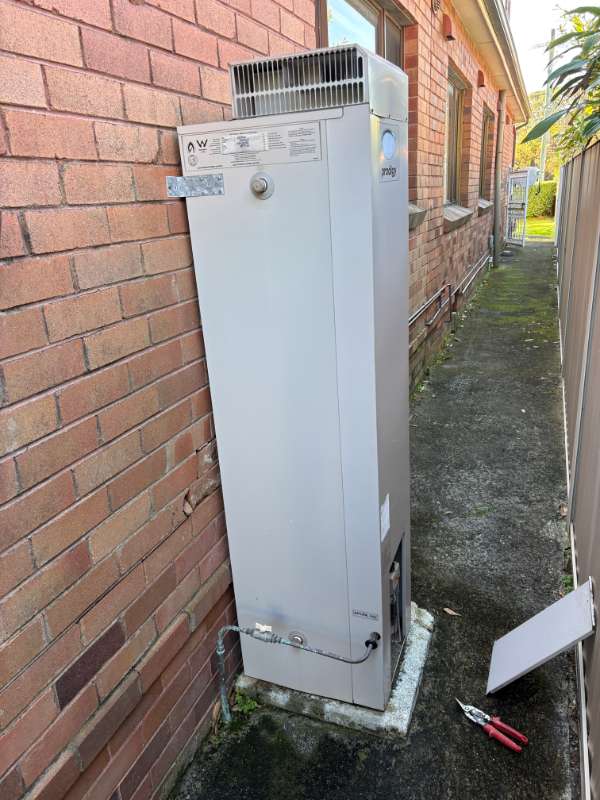
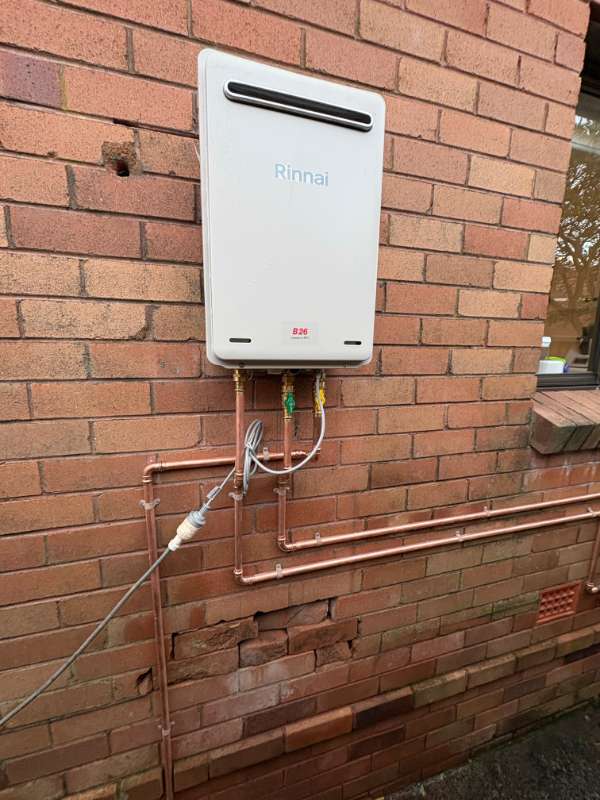
Old gas tank replaced with continuous flow, Maroubra (nearby)
The problem: the gas storage tank down the side of a Maroubra home had stopped sending hot water to the taps.
What we did: we went through repairing against replacing and the systems that would suit, and the owners chose a Rinnai continuous flow unit. We took out the old tank, mounted the new unit on the wall, upsized the copper pipework and replaced the gas regulator at the meter so the new system gets enough gas.
The result: reliable hot water at every tap, on a gas supply sized for the new unit.
More local work is on our recent projects page.
Hot water across Phillip Bay
- Along Yarra Road: older homes where the system has often been moved or replaced before, and the pipework behind it deserves a look.
- Near Bicentennial Park and the foreshore: units that face the salt every day and corrode fastest.
- Towards Yarra Point and Bumborah Point: windy, exposed spots where flue position and pilot reliability matter.
- Villas and townhouses: compact units in tight spaces, where getting the size and clearances right takes care.
- Small flat blocks: electric tanks in cupboards, where a safe drain for the relief valve is essential.
Finding a sheltered spot
When a system is replaced, it's worth asking whether the old spot is still the best one. A side wall out of the prevailing wind, under an eave and away from direct sea spray, can add years to a unit's life. It also needs to be reachable for servicing, close enough to the bathroom and kitchen that you're not waiting ages for hot water, and clear of windows and openings for gas flues. We'll walk around the house with you and suggest the options.
The relief valve and why it drips
Every storage system has a temperature and pressure relief valve. It lets a little water out as the tank heats, which is normal. If it runs constantly, either the valve has worn, salt and scale have stopped it seating, or the mains pressure is too high. Replacing the valve fixes the first two. If pressure is the cause, a pressure limiting valve protects the new valve and everything else in the house. Our pressure limiting valve page explains more. Valves should be replaced about every five years, and sooner near the sea.
Tempering valves and safe hot water
Hot water is stored hot enough to stop bacteria growing, but at that temperature it can scald quickly. A tempering valve mixes in cold water so the bathroom taps deliver water at a safer temperature. If your shower has suddenly gone lukewarm or too hot after years of being fine, the tempering valve is often the cause. They wear out like any valve and can be replaced in one visit.
Hot water and summer visitors
Summer on the peninsula means a lot of sandy showers. If your household doubles over the holidays, a storage tank sized for two or three people will run out. Before you replace it with a bigger tank, it's worth checking it's actually working properly: a failed lower element or a heavy layer of sediment can halve a tank's useful capacity. If it is healthy and simply too small, continuous flow or a larger tank are the usual answers.
Continuous flow error codes
Continuous flow units show a number on the controller when something is wrong. Some codes mean the unit can't light, often because the gas is off, the regulator is struggling or wind has got into the flue. Others point to a water flow problem, such as a blocked inlet filter, or to an internal fault. Before you call, write down the code and the model, and check whether the gas cooktop is working. That helps us bring the right parts. Turning the unit off and on at the power point is fine to try once, but if the code keeps coming back there is a reason, and resetting it over and over won't fix it.
Signs your system is near the end
- It's more than about ten years old and has spent its life outdoors in salt air.
- There's rust on the base or weeping around the bottom of the tank.
- You've had more than one repair in the past couple of years.
- The hot water has become rusty or smells odd.
- It rumbles and pops loudly every time it heats.
If two or three of these sound familiar, it's worth planning a replacement rather than waiting for a cold shower. You get time to compare systems and choose a better spot, instead of taking whatever is in stock on the day.
Questions to ask before replacing
- Is the system actually finished, or is this a repair?
- Is the new system sized for how many people live here now?
- Is the gas supply or electrical circuit big enough for it?
- Is the current spot the best one, or is there a more sheltered wall?
- What warranty comes with the system, and with the workmanship?
Looking after your hot water
- Ease the relief valve lever every six months.
- Hose salt off the outer casing and fittings now and then, with the power or gas off and the unit cool.
- Keep the area around the unit clear so air can reach a heat pump fan or a gas flue.
- Have a gas system serviced every couple of years.
- Note the installation date on the unit so you know when it's getting old.
Regular checks with the Priority Plan
Because outdoor systems near Yarra Bay age faster, a yearly look is worth more here than in most suburbs. On our Priority Plan, your free annual plumbing health check includes the hot water system: we test the relief and tempering valves, look for corrosion on the casing and fittings, check the flue on gas units and tell you roughly how much life the system has left. Members also get 10% off for the year and priority booking. See our Priority Plan.
Hot water words explained
- Relief valve: the safety valve at the top of a storage tank that releases water if temperature or pressure get too high.
- Tempering valve: a valve that mixes hot and cold so bathroom taps deliver safer hot water.
- Anode: a sacrificial rod inside a tank that corrodes so the tank doesn't.
- Continuous flow: a unit that heats water only as it flows, with no storage tank.
- Heat pump: a system that uses a fan and refrigerant to move heat from the air into the water.
- Regulator: the device at the gas meter that sets the gas pressure to the house.
What happens when you call
Tell us what's going on
Call or send a quick form. A photo of the problem helps us come prepared. No call-out fee.
Options and a fixed price first
We find the cause, explain your options and give you a fixed price for each before any work starts.
Fixed, tested and backed
We do the work, test it, clean up, and back our workmanship with a lifetime labour warranty.
Why Phillip Bay homeowners call us
- Based in Matraville, a short drive from Phillip Bay
- Rated 5.0 from 110 Google reviews
- Free quotes, with options and a fixed price before any work starts
- Lifetime labour warranty on our workmanship
- Licensed plumbers, drainers and gasfitters (Lic. 398171C)
Hot water questions from Phillip Bay homeowners
How long should a hot water system last near the bay?
Systems outdoors near the sea often have a shorter life than the same model inland, because salt attacks the casing, valves and fittings. Regular checks and a sheltered spot help it last longer.
My relief valve is dripping. Is that normal?
A small amount while the tank heats is normal. A constant drip or steady flow isn't. The valve may need replacing, or the water pressure may be too high.
Should I repair or replace my system?
If the tank is leaking, it needs replacing. Otherwise it depends on age, condition and the cost of the repair. We'll give you both options with a fixed price so you can decide.
Is continuous flow a good choice for my home?
It suits many homes, especially where space is tight or hot water runs out. It needs a gas supply big enough for the unit, and a flue position that suits the wind. We'll check both.
Will a heat pump work this close to the sea?
Yes, if you choose a model suited to coastal conditions and place it where the fan gets good airflow without direct sea spray.
Why is my hot water rusty?
Rusty hot water can mean the anode is used up and the tank is starting to corrode inside, or it can come from old galvanised pipe. We'll check which.
My gas pilot keeps blowing out. What can I do?
Wind is a common cause in exposed spots. A failing thermocouple can also do it. We'll find the cause, and if the system is due for replacement, we can suggest a better position or a system without a standing pilot.
Do I need a bigger system?
Not always. A failed element or heavy sediment can make a healthy-sized tank run out early. We check that first before recommending a bigger system.
Can you move my hot water system to a different spot?
Often, yes, when it's being replaced. We'll look at the options, including the pipework, gas supply, drainage and flue clearances.
What's a tempering valve and do I need one?
It mixes cold into the hot water so bathroom taps deliver safer hot water. It's a requirement for most new installations.
Do I get paperwork for a new system?
Yes. You get a compliance certificate, and for gas work the paperwork the law requires is lodged.
Is your work guaranteed?
Yes. Our workmanship carries a lifetime labour warranty, and new systems come with the manufacturer's warranty.
More plumbing in Phillip Bay: our Phillip Bay plumber page, gas fitting, blocked drains and leak detection. Nearby: hot water in La Perouse and Little Bay. Guides: choosing a hot water system, pressure limiting valves and our Priority Plan.