Gas fitting in Phillip Bay 2036
Gas pipes and meters in Phillip Bay live a hard life. Most meters sit on an outside wall or in the front garden, a few streets from Yarra Bay, and salt air works on the steel and brass every day. Older homes along Yarra Road may also have gas pipework that has been added to over many years. We're based in Matraville, work across the peninsula every week, and know what to look for in homes this close to the water.
Gas work we do in Phillip Bay
Cooktops and ovens
Old cooktops disconnected and new ones connected, leak tested and checked for correct flame.
Gas heaters and bayonets
Heaters serviced or replaced, and new bayonet points added where you want them.
Gas hot water
Storage and continuous flow systems installed, with the gas supply sized to suit.
Outdoor BBQ points
A fixed gas point on the deck or patio, so you can stop swapping bottles.
Gas leaks
Leaks found, isolated and repaired, with the whole installation pressure tested.
Meter-side pipework
Rusted risers and fittings near the meter replaced with pipe that suits the coast.
Signs you need a gasfitter
- A smell of gas inside or near the meter.
- Yellow or lazy flames on the cooktop instead of crisp blue ones.
- Soot or scorching around a heater, oven or hot water flue.
- A hissing sound near a gas pipe or appliance.
- Rust and flaking on the pipe where it leaves the meter or enters the ground.
- A heater that won't stay lit or smells when it runs.
- A gas bill that's crept up without any change in how you use gas.
Why gas jobs come up in Phillip Bay
Salt and the meter
Galvanised steel risers and brass fittings at the meter corrode faster near the sea. In Phillip Bay we often find rust at ground level where the pipe comes out of the soil, flaking on the riser behind the meter, and fittings that weep a small amount of gas. These are easy to miss because they're outside, but they're worth fixing before they get worse.
Pipework added to over the years
Many of the older cottages and bungalows on Yarra Road have had gas extended for a new cooktop, a heater point, a hot water system and maybe a BBQ, often at different times. Each addition can be fine on its own, but the pipe from the meter may no longer be big enough to run everything at once. That shows up as weak flames or a continuous flow unit that won't fire properly.
Wind off the bay
Strong wind off Botany Bay can affect outdoor appliances. Flues need the right clearances from windows, doors and corners so gusts don't push combustion gases back, and older appliances with standing pilots can blow out. Where an appliance is placed is part of doing the job properly.
Pipes under timber floors
Older homes on stumps often have gas pipe run under the floor. Damp, sandy subfloors near the bay can corrode older steel pipe from the outside, where nobody sees it. When we work on a gas installation, we check what we can reach.
Phillip Bay homes and their gas
| Home type | What we often see | What helps |
|---|---|---|
| Older cottages and bungalows | Steel pipe extended several times, sometimes under the floor | A full pressure test and sizing check before adding anything new |
| Detached homes near the foreshore | Rusted risers and fittings at the meter | Replacing exposed pipe with coast-suited materials |
| Villas and townhouses | Meters grouped together, tight spaces for appliances | Careful flue and clearance planning |
| Small blocks of flats | Meter banks and long runs to each unit | Clear labelling and testing of your own line |
| Homes with outdoor entertaining | Bottled BBQs on decks | A fixed gas point with a proper bayonet |
How a gas job runs
- Talk it through. What you want connected or fixed, and where. Photos of the meter and appliance help.
- Check the installation. We look at the meter, regulator and pipework, and test for leaks before changing anything.
- Check the supply. If you're adding an appliance or a continuous flow unit, we work out whether the existing pipe and regulator can carry the load.
- Give you options. Each with a fixed price, before any work starts.
- Do the work. Pipework, connections and appliances installed to the gas standards.
- Test and commission. Pressure test, check for leaks, check flames and flues, and show you how to turn it off.
- Paperwork. The certificate and paperwork the law requires are lodged, and you get a copy.
Repair, extend or run a new line?
| Situation | Usually | Why |
|---|---|---|
| One fitting weeping at the meter | Repair that fitting | The rest of the pipe is sound |
| Rust along the riser and into the ground | Replace the exposed section | Corrosion spreads and weakens the pipe |
| Adding a cooktop or BBQ point | Extend from the existing line | If the supply is big enough |
| Adding continuous flow hot water | Upsize the line and regulator | These units need a lot of gas at once |
| Old pipe under the floor in poor condition | Run a new line | Repairs to old pipe often lead to more leaks |
What affects the cost
- What's being connected, and how far from the meter.
- Access: under-floor spaces, walls and tight side passages.
- Pipe size: whether the existing line can carry the extra load.
- The meter regulator: whether it needs replacing for a bigger appliance.
- Making good: any patching of walls or paving after the work.
You get a fixed price before any work starts.
Who's responsible?
- The gas network (Jemena in Sydney): the gas main, the service pipe to the meter, and the meter itself.
- You, the homeowner: all the pipework after the meter, and your appliances.
- Your gas retailer: your account and billing.
- Shared meter banks: in flats and townhouse groups, each home's line from the meter bank is usually its own. Shared pipework is looked after by all the owners together, so we'll explain anything we find on it.
Safety checks you can do
- Know where your gas meter is and how to turn it off. The valve handle is turned across the pipe to close it.
- Look at the flames on your cooktop. They should be blue with a crisp shape. Yellow, floppy flames need checking.
- Look for soot or scorch marks around heaters and the hot water flue.
- Look at the pipe at the meter for rust, flaking or bubbling paint.
- Never use an unflued gas heater in a closed room, and keep vents clear.
Signs it's urgent and when it can wait
- If you smell gas strongly: turn it off at the meter, don't use switches or flames, get everyone outside, and call Jemena's faults line. Then call us to find and repair the leak.
- Call soon if there's a faint smell near the meter, flames have changed colour, or there's soot around an appliance.
- Book a time if you want a new cooktop, a heater point, a BBQ point, or rust at the meter checked.
A recent gas job nearby
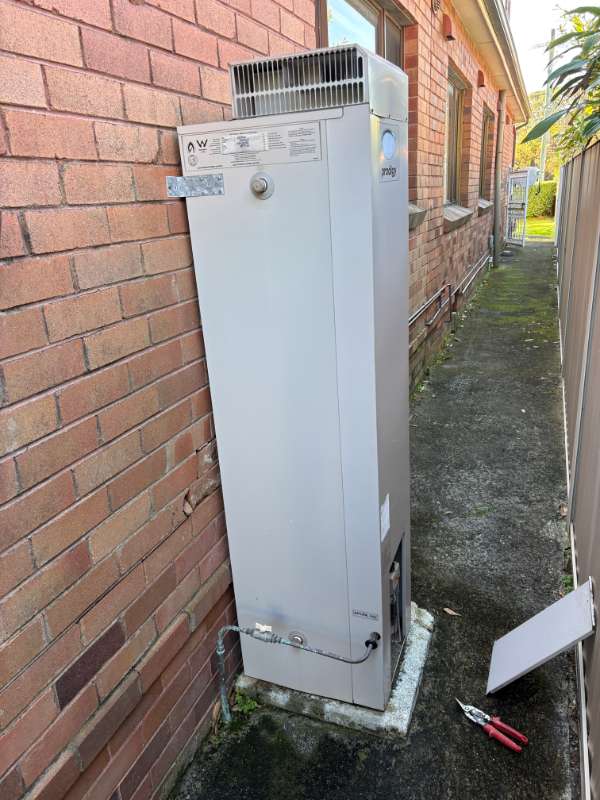
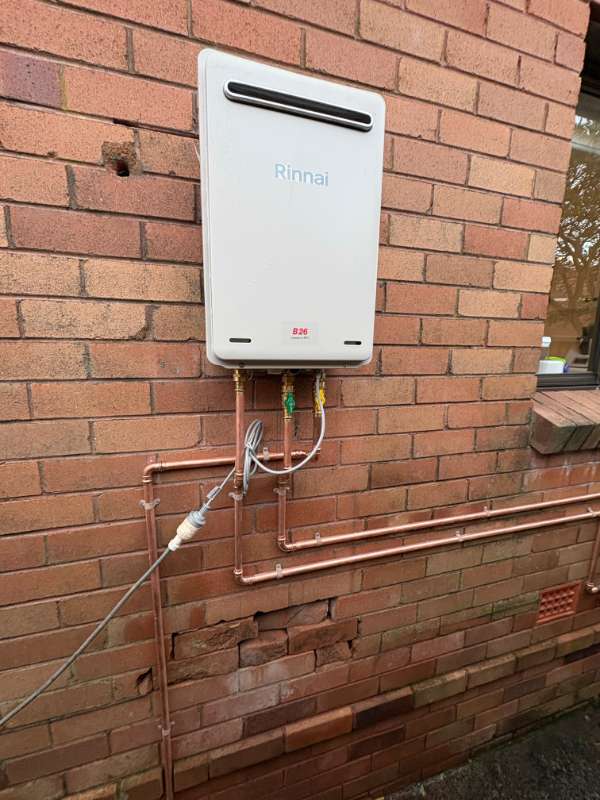
This job nearby in Maroubra shows why we check the gas supply, not just the appliance.
Gas hot water upgraded and regulator replaced, Maroubra (nearby)
The problem: the old gas storage hot water tank down the side of a Maroubra home had stopped sending hot water to the taps.
What we did: the owners chose a Rinnai continuous flow unit. A continuous flow unit draws much more gas at once than a storage tank, so as well as removing the old tank, mounting the new unit and upsizing the copper pipework, we replaced the gas regulator at the meter to give the new unit the supply it needs.
The result: the new unit fires properly at every tap, and the gas supply is sized for it.
More local work is on our recent projects page.
Gas across Phillip Bay
- Along Yarra Road: older homes with gas added over decades, often worth a sizing check before adding anything new.
- Near Bicentennial Park and the foreshore: meters and risers closest to the salt, where corrosion is most common.
- Towards Yarra Point and Bumborah Point: exposed blocks where flue placement for outdoor appliances matters.
- Villas and townhouses: grouped meters and tight spaces for hot water and heaters.
- Around Elaroo Avenue: a mix of older and newer homes, with gas set-ups to match.
Corrosion near the meter
If you look at your gas meter and see rust where the pipe goes into the ground, or paint bubbling and flaking on the riser, don't ignore it. That pipe holds gas at pressure, and once corrosion gets a hold it keeps going. The fix is usually to replace the exposed section with pipe and fittings that stand up better to salt air, and to wrap or protect any steel that stays. It's a tidy job, and it saves a much bigger one later.
Cooktops and ovens
Swapping a gas cooktop looks simple, but it needs a licensed gasfitter. The new cooktop has to suit the existing gas type, the connection must be leak tested, and the burners checked for correct flame. Many new cooktops need a regulator fitted at the appliance as well. If you're moving the cooktop to a new position, we'll extend the line to suit. See our gas cooktop installation page.
Heaters and bayonet points
Gas heaters are a common way to warm older Phillip Bay homes through winter, when the wind comes off the bay. A bayonet point lets you plug a portable gas heater into the wall. We can add new points, service existing heaters and replace faulty ones. Have heaters serviced every couple of years, and don't use one with a cracked or sooty face.
Outdoor BBQ points
If you cook outdoors a lot, a fixed gas point on the deck or patio means no more running out of gas halfway through. We run a line from the existing installation, fit an outdoor bayonet with a cover, and test it. In salty air, we use fittings that suit the conditions and position the point where it won't sit in water.
Gas supply for bigger appliances
Every gas appliance needs a certain amount of gas. When you add up a cooktop, a heater, a continuous flow hot water unit and a BBQ, an older line from the meter may not be big enough to run them all at once. The signs are weak flames when the hot water is on, or a continuous flow unit that shows an error under load. We calculate what your home needs and upsize the pipe or regulator if it's short. That's what we did on the Maroubra job above.
Gas or induction?
Some homeowners are weighing up a gas cooktop against induction. There's no single right answer. Gas gives instant, visible heat and works with any pan. Induction is fast and easy to clean but needs suitable pans and the right electrical circuit. If you decide to stay with gas, we'll install it properly. If you decide to stop using gas, we can safely disconnect and cap appliances and lines that are no longer needed.
Old points nobody uses
Older homes often have gas points that haven't been used in years: an old heater bayonet in a back room, a capped line where a stove used to be, a pipe to a hot water system that's long gone. Unused gas pipework still holds gas. We can check these during a visit and properly cap or remove any that aren't needed.
Gas hot water by the bay
Gas hot water is the biggest gas appliance in most homes. A storage tank with a standing pilot uses a modest amount of gas all the time; a continuous flow unit uses nothing until a tap opens, then a lot at once. Either way, outdoor units near Yarra Bay face salt and wind. When we install one, we look at the flue position, the distance to the meter, the pipe size and how exposed the wall is. Our Phillip Bay hot water page covers choosing a system.
Heaters and fresh air
Flued heaters send combustion gases outside through a flue. Unflued portable heaters release them into the room, which is why rooms with them need permanent ventilation and the heater needs to be in good condition. Signs a heater needs attention include a yellow flame, a smell when it runs, condensation on windows, soot on the face, or headaches and stuffiness. If you notice any of these, turn the heater off and have it checked before using it again.
Before you call
- Take a photo of the gas meter and the pipe around it.
- Note the brand and model of the appliance you want connected or fixed.
- Think about where you want any new point, such as a heater bayonet or BBQ connection.
- If you're replacing a cooktop, check the new one's installation instructions are in the box.
- Let us know about any gas smell, even a faint one, when you call.
Planning new gas work
If you're thinking about a new cooktop, a heater point and gas hot water over the next few years, it's worth planning them together. Sizing the pipe once for everything you'll eventually connect is simpler than upsizing it piece by piece. We can look at the whole installation, tell you what it can carry now, and what it would take to carry everything you have in mind. That way each job fits into the next, rather than one addition starving another of gas.
Buying an older home in Phillip Bay?
Gas is rarely looked at closely in a building inspection. On an older cottage or bungalow, it's worth knowing what condition the meter-side pipe is in, whether there's old pipe under the floor, whether unused points are properly capped, and whether the supply could carry a continuous flow hot water unit if you want one later. We can check the installation, pressure test it, and give you a plain list of what's fine and what needs attention, with a fixed price for any work.
Why the regulator matters
The regulator at the meter steps the gas down to the right pressure for your home. If it's too small or failing, appliances further from the meter can struggle, especially when several run together. Regulators near the sea can also corrode on the outside. A regulator that hums, or flames that drop when the hot water fires, are worth a check.
Small jobs, done properly
Some gas jobs are small: a cooktop hose, a bayonet that sticks, a regulator that hums, a meter-side fitting that weeps. They still need a licensed gasfitter, a leak test and paperwork. If you have a few small things on the list, book them together and we'll check the rest of the installation while we're there.
Looking after gas appliances
- Have gas heaters serviced every couple of years.
- Keep cooktop burners clean so flames stay even.
- Keep the area around the meter clear so it can be read and turned off.
- Check outdoor pipework and the meter area for rust once or twice a year.
- Replace a flexible cooktop hose if it's kinked, cracked or near a heat source.
Gas words explained
- Meter: measures your gas use; belongs to the network.
- Regulator: sets the gas pressure into the house.
- Riser: the pipe that comes out of the ground to the meter.
- Bayonet: a wall or floor point for plugging in a portable heater or BBQ.
- Pressure test: a check that the pipework holds pressure with no leaks.
- Flue: the outlet that carries combustion gases away from an appliance.
What happens when you call
Tell us what's going on
Call or send a quick form. A photo of the problem helps us come prepared. No call-out fee.
Options and a fixed price first
We find the cause, explain your options and give you a fixed price for each before any work starts.
Fixed, tested and backed
We do the work, test it, clean up, and back our workmanship with a lifetime labour warranty.
Jobs we finished recently
Why Phillip Bay homeowners call us
- Based in Matraville, a short drive from Phillip Bay
- Rated 5.0 from 110 Google reviews
- Free quotes, with options and a fixed price before any work starts
- Lifetime labour warranty on our workmanship
- Licensed plumbers, drainers and gasfitters (Lic. 398171C)
Gas fitting questions from Phillip Bay homeowners
Can I swap my own gas cooktop?
No. In NSW, gas work must be done by a licensed gasfitter, including connecting a new cooktop. It needs to be leak tested and certified.
What should I do if I smell gas?
Turn the gas off at the meter, avoid switches and flames, get everyone outside and call Jemena's faults line. Then call us to find and fix the leak.
There's rust on the pipe at my meter. Is that a problem?
It should be checked. Corrosion near the meter is common close to the sea and gets worse over time. Replacing the exposed section is usually a simple job.
Why are my cooktop flames yellow?
Yellow flames usually mean the burner isn't getting the right mix of gas and air, often from dirt, a blocked burner or the wrong pressure. Have it checked.
Is my gas line big enough for continuous flow hot water?
Often not in older homes. These units need a lot of gas at once. We'll calculate your needs and upsize the pipe or regulator if needed.
Can you add a gas point for a BBQ?
Yes. We run a line from your existing installation, fit an outdoor bayonet, and test it.
Do you lodge the paperwork?
Yes. Every gas job is tested, and the certificate and paperwork the law requires are lodged. You get a copy.
Who owns the gas meter?
The gas network owns the meter and the supply up to it. Everything after the meter is yours.
How often should a gas heater be serviced?
Every couple of years, or sooner if it smells, is slow to light, or shows soot.
Can you cap off old gas points?
Yes. Unused points still hold gas, so we can check and cap or remove any you don't need.
Does wind affect outdoor gas appliances?
It can. Flues need the right clearances and position so gusts don't push gases back. We plan placement with that in mind.
Is your gas work guaranteed?
Yes. Our workmanship carries a lifetime labour warranty.
More plumbing in Phillip Bay: our Phillip Bay plumber page, hot water, leak detection and blocked drains. Nearby: gas fitting in La Perouse and Little Bay. Guides: gas cooktop installation, choosing a hot water system and our Priority Plan.