Leak detection in Botany 2019
Botany has been tied up with water for a long time. In the 1850s, before Sydney's dams were built, the swamps that drained to the Botany foreshore supplied much of the city's water, and the old waterworks site still sits near the edge of the airport. These days the water comes from the main in the street, and the leaks we chase are much smaller, but they can be just as hard to see. In Botany's low, sandy ground, a leaking pipe can drain away for months without a single puddle. Here's how to tell if you have one and how we find it.
Signs of a hidden leak
- A water bill that jumps with nothing else changing.
- The meter moving when every tap is off.
- Brown water first thing in the morning and low pressure, which often go with old galvanised pipe that's also leaking.
- A hissing sound in a wall or under the floor.
- Damp, mould or bubbling paint low on a wall or near a shower.
- A stain on the ceiling of an apartment or a townhouse below a bathroom.
- Loose tiles around a shower or on a bathroom floor.
- A warm patch on a tiled floor.
Where leaks hide in Botany homes
Galvanised pipe in older cottages and terraces
The original cottages, semis and terraces either side of Botany Road were often plumbed in galvanised steel. It rusts from the inside, narrowing the pipe and thinning the wall until it pinholes. The first signs are usually low pressure and rusty water, then a leak somewhere you can't see: under the floor, inside a wall, or at a threaded joint behind the laundry tub.
Sandy ground near the bay
Much of Botany is flat, low-lying and sandy, close to the bay. Water leaking from a buried pipe drains straight down rather than spreading, so you won't see a wet patch. The pipe from the meter to the house is the classic culprit. It may have been in the ground for decades.
Shared walls in terraces and semis
In a semi or terrace, a leak in your wall can show up on your neighbour's side, and theirs on yours. Damp on a party wall needs finding at the source, not just painting over. We work out which side the water is coming from before anything is opened up.
Apartments and townhouses
Botany has plenty of newer apartments and townhouses. Shower leaks, failed waterproofing, split braided hoses and washing machine leaks show up as stains in the home below or next door. The newer homes also have plastic pipe in walls and slabs, where fittings can fail and leak quietly.
Toilets, hot water and irrigation
Some of the biggest leaks aren't in the walls at all: a toilet leaking into the bowl, a hot water relief valve running to the drain, or a garden irrigation line with a broken fitting. We always check these first.
Botany homes and the leaks we find
| Home type | Most common leak | How we usually find it |
|---|---|---|
| Cottages and semis near Botany Road | Galvanised pipe under the floor or in walls | Isolate the house, test sections, inspect under the floor |
| Terraces | Party wall and under-floor leaks, old water service | Section testing and moisture readings on both sides |
| Post-war brick homes | Water service across the front yard | Isolate the service and test it on its own |
| Apartments | Shower and hose leaks into the unit below | Find the source in the unit above, then repair |
| Townhouses | Pipes in slabs and walls | Section testing, thermal imaging, listening |
How we find a leak
- Confirm it at the meter with everything off, and get an idea of how fast water is escaping.
- Rule out the usual suspects: toilets, the hot water relief valve, irrigation and garden taps.
- Split the system. We isolate the water service from the house, then sections inside, reading the meter each time.
- Pinpoint it by listening along the pipe, thermal imaging on hot lines, moisture readings and a look under the floor.
- Show you and price it. We explain where the leak is and give you a fixed price for each repair option.
- Fix and retest at the meter to make sure there's no second leak.
Galvanised pipe leaks
Leaking galvanised sections found, and repaired or replaced with copper or modern pipe.
Water service leaks
Leaks in sandy front yards found without digging up the whole lawn.
Under-floor and slab leaks
Leaks under timber floors and slabs narrowed down so only a small area is opened.
Shower and wall leaks
Leaks behind tiles and in walls traced to the pipe, mixer or seals.
Leaks into the home below
The source found in the unit or townhouse above, with a report for the owners.
Toilet and hot water leaks
Silent cistern leaks and running relief valves found and fixed.
Repair the leak or replace the pipe?
| What we find | Repair the spot | Replace or reroute |
|---|---|---|
| One leaking joint on sound copper | Yes | Not needed |
| Galvanised pipe pinholed | A short-term fix | Replace the galvanised section or the lot |
| Old water service leaking in sand | If the rest is sound | A new service if it's old or leaked before |
| Hot pipe leaking in a slab | If reachable | Often a reroute through a wall or ceiling |
| Shower mixer connection in the wall | Repair the connection | A new mixer if it's old |
What affects the cost
- How long it takes to pinpoint: a toilet leak is quick; a slab leak takes more testing.
- Where it is: subfloor, slab, wall or yard.
- The repair: a joint, a section or a reroute.
- Pipe condition: galvanised often needs more replaced.
- Making good: lawn, paving, tiles or plaster.
You get a fixed price for each option before any repair starts.
Who's responsible?
- Sydney Water: the main in the street and the meter.
- You: every pipe on the house side of the meter, including the water service under the front yard.
- Apartments and townhouses: pipes in your own home are usually yours; shared pipes are usually the owners' together. A leak from the home above is usually that owner's to fix.
- Semis and terraces: each owner looks after their own pipes; a shared water service, if there is one, is usually shared.
Quick checks before you call
- Turn off every tap and appliance, note the meter, use no water for an hour, then read it again.
- Put a few drops of food colouring in each toilet cistern. If colour shows in the bowl within 20 minutes without flushing, it's leaking.
- Check the hot water relief valve drain for a steady flow.
- Turn off the irrigation and any pool top-up and check if the meter stops.
- Look low on walls near showers and on ceilings below bathrooms for stains or bubbling paint.
Signs it's urgent and when it can wait
- Call straight away if water is coming through a ceiling, near electrics, or the meter is spinning fast.
- Call soon if the meter moves with everything off, or there's new damp on a wall or ceiling.
- Book a time if your bill is a little higher than usual and you'd like it checked.
A recent water pipe repair nearby
Here's a recent water service repair nearby in Matraville, a few minutes east of Botany.
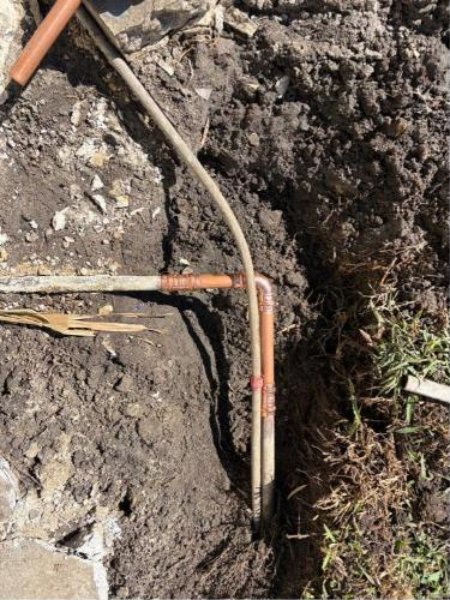
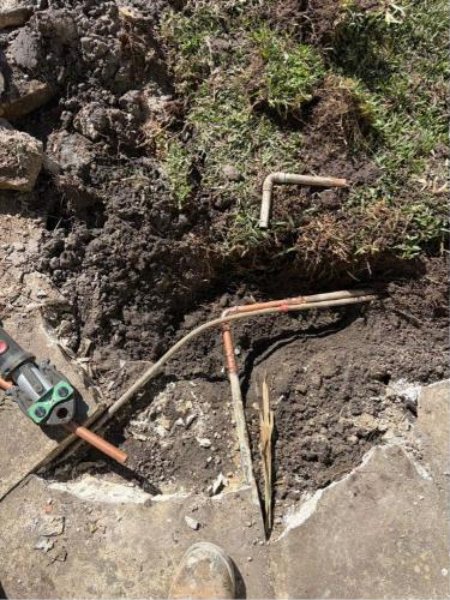
Damaged copper water service repaired, Matraville (nearby)
The problem: a crane lifting a pool into the property next door damaged the buried copper water service in a Matraville backyard.
What we did: the pipe had been dug out and the water turned off when we arrived. Only the stretch under the lawn beside the paving was damaged, and the rest of the copper was sound, so we cut out the damaged length and joined in new copper and fittings.
The result: the water was back on in under an hour, every tap in the house ran properly, and the rest of the line didn't need replacing.
More local work is on our recent projects page.
“I called [the team at] Scalici Plumbing Group to clear my blocked drain and fix my leaking toilet in Maroubra. Great company to deal with, highly recommended.”
Chris L., Maroubra (Google review)
Leaks across Botany, area by area
- Either side of Botany Road: the oldest homes, where galvanised pipe and old water services are common.
- Around St Matthew's and the older streets: semis and terraces with shared walls and narrow access.
- Towards the bay and Sir Joseph Banks Park: low, sandy ground where buried leaks drain away unseen, and salt air on outdoor pipes.
- The Mascot and Pagewood sides: post-war brick homes with water services across the front yard.
- Newer apartments and townhouses: leaks into the home below and pipes in slabs.
Brown water, low pressure and leaks
In older Botany homes, brown water first thing in the morning, low pressure at the shower, and a hidden leak often turn out to be the same problem: galvanised pipe at the end of its life. The rust that colours the water is the same rust thinning the pipe wall. Fixing the leak alone gets the water back on, but the next pinhole is rarely far away. If we find galvanised pipe, we'll show you and give you a fixed price to replace it in stages or all at once. See our galvanised pipes guide and brown hot water.
Bores and groundwater in Botany
Some older Botany homes have, or once had, a backyard bore. There are NSW restrictions on using groundwater in parts of the Botany area because of contamination in the sands under the suburb, so don't use bore water without checking the current rules first. If a bore is connected to your plumbing in any way, it should be properly separated from the mains supply with the right backflow protection. If you're not sure how an old bore is connected, we can check.
Leaks from upstairs or next door
A ceiling stain or a damp wall in a Botany apartment or townhouse isn't always your plumbing. Water from a shower, bath or washing machine above or next door can travel a long way before it shows. We find where it's coming from first, so the right owner fixes it, and we'll give you a short written report with photos to pass on to them or the owners corporation.
Before a new bathroom or kitchen goes in
If you're about to put a new bathroom or kitchen into an older Botany home, test the pipes first. With walls and floors open, replacing old galvanised or tired copper costs far less than finding and fixing a leak after the new tiles are down.
A typical terrace leak, step by step
- The owner's bill has gone up and the meter moves with everything off. There's damp on the party wall in the hallway.
- We check the toilets and the hot water relief valve. Both are fine.
- We isolate the water service at the house end. The meter stops, so the leak is inside.
- We isolate the hot water. The meter starts again, so it's on the cold side.
- Moisture readings along the hallway wall point to the point where the cold pipe runs up to the bathroom.
- We open a small section of wall, find a pinholed galvanised elbow, and replace that run with copper.
- The meter is read again with everything off. It stays still.
Leak words explained
- Water service: the pipe from the meter to the house.
- Galvanised pipe: zinc-coated steel pipe used in older homes, which rusts from the inside.
- Section testing: isolating parts of the plumbing one at a time and watching the meter.
- Party wall: the shared wall between two semis or terraces.
- Relief valve: the safety valve on a hot water system.
- Backflow protection: a device that stops water flowing back into the mains supply.
Outdoor pipes near the bay
Homes on the southern side of Botany, towards the foreshore and Sir Joseph Banks Park, get the sea breeze off Botany Bay. Outdoor copper and brass, the pipes at the hot water system, garden taps and the meter connection all corrode faster there. Green or white crust on a fitting is the first warning. A weep at a fitting outside may not look like much, but it runs day and night and often ends up in a garden bed where nobody sees it. Walk around the house every few months and look at every visible pipe and fitting.
Hot water leaks
Storage hot water systems leak in two main ways. The relief valve on top lets out water through a small drain pipe, and if it runs constantly it can point to high mains pressure or a faulty valve. The tank itself can also start to leak as it rusts through, usually from the bottom, and once that starts it can't be repaired. If there's water pooling under your hot water system, or the relief valve drain is always wet, mention it when you call. Continuous flow units in apartments and townhouses can also leak at their connections, often on a balcony wall where it's easy to miss. See relief valve dripping.
Dampness in terraces and cottages
Many of Botany's older terraces and cottages have low timber floors with limited ventilation underneath. A slow leak under the floor keeps the ground damp and the air under the house humid, which is hard on the floor framing and can cause musty smells and mould inside. If your home smells musty, the floor feels soft in places, or there's mould at the bottom of walls, a hidden leak is one of the first things to rule out. Once it's fixed, clearing blocked subfloor vents helps the space dry out.
Washing machines and dishwashers in apartments
In apartments and townhouses, the washing machine and dishwasher are often in a cupboard or under a bench above someone else's ceiling. Their hoses are under mains pressure whenever the taps are on, and a split hose can run for hours. Replace machine hoses every few years, check dishwasher connections when you clean under the sink, and turn the machine taps off when you go away. If your laundry cupboard has no floor waste, a tray under the washing machine can catch a slow leak before it reaches the ceiling below.
While you wait for us
- If water is visible and spreading, turn off the main stop tap at the meter.
- Turn off the hot water at the switchboard, or set a gas unit to off, if hot water is leaking.
- Move rugs, furniture and anything electrical away from the water.
- In an apartment, let the neighbour below know, and the building manager if there is one.
- Take photos of the damage and the meter reading.
A leak-check routine for Botany homes
- Each bill: compare usage with the same quarter last year.
- Twice a year: do the one-hour meter test and the food colouring test on every toilet.
- Every few months near the bay: look at outdoor pipes and fittings for crust or weeping.
- Every few years: replace washing machine hoses and any braided hose showing rust or fraying.
- Before going away: turn the water off at the meter if the house will be empty for more than a few days.
Common causes we find in Botany
- Galvanised steel rusting through at threads and elbows.
- Copper rubbing on brick piers or bearers under low timber floors.
- Joins between old and new pipe, especially copper joined to galvanised.
- Old water services in sand that have lost their bedding.
- Failed shower waterproofing in bathrooms from the 1980s and 1990s.
- Perished braided hoses under sinks and toilets. See flexi hose replacement.
- High mains pressure straining every fitting. A pressure limiting valve helps.
Leaks and the water bill
Water lost on your side of the meter goes through the meter, so you pay for it, and on most bills you also pay sewer usage on it. A small leak running all day adds up over a quarter. Keep our invoice describing the leak and the repair with your water account papers, and read the meter again a week or two after the repair to be sure it's still.
Leaks under concrete in newer Botany homes
Townhouses, duplexes and rebuilt homes in Botany are mostly on concrete slabs, with water pipes running through the slab or in the walls just above it. A leak on the hot side often gives itself away as a warm strip of floor, which a thermal camera picks up clearly. A cold water leak is harder because there's no heat to follow, so we rely on section testing, listening and moisture readings at the edges of the slab. Once we know roughly where it is, the choice is usually between opening a small section of floor to repair it, or abandoning that pipe and running a new one through the walls or ceiling. Rerouting often causes less disruption, especially under tiles or timber flooring you'd rather not lift. We'll price both.
What happens when you call
Tell us what's going on
Call or send a quick form. A photo of the problem helps us come prepared. No call-out fee.
Options and a fixed price first
We find the cause, explain your options and give you a fixed price for each before any work starts.
Fixed, tested and backed
We do the work, test it, clean up, and back our workmanship with a lifetime labour warranty.
Why Botany homeowners call us
- Based in Matraville, the suburb next door
- Rated 5.0 from 110 Google reviews
- Free quotes, with options and a fixed price before any work starts
- Lifetime labour warranty on our workmanship
- Licensed plumbers, drainers and gasfitters (Lic. 398171C)
Leak detection questions from Botany homeowners
How do I know if I have a hidden leak?
Turn off every tap and appliance and watch the meter for an hour. If it moves, water is escaping.
Why is there no wet patch if the leak is outside?
Botany's sandy ground lets water drain straight down, so a buried leak often leaves no puddle.
Is brown water a sign of a leak?
Often it's old galvanised pipe rusting inside, which also tends to leak. We check both.
My neighbour's wall is damp. Is it my pipe?
It could be either side. We find the source before anything is opened up.
Do you have to dig up my floor?
No. We narrow it down by section testing and open only where the leak is.
Is a leak at the meter my responsibility?
No. The meter and the street side are Sydney Water's.
Can you find leaks in apartments?
Yes, including leaks from the unit above. We give you a report for the other owner.
Can I use my old bore?
Check the current NSW rules first. There are groundwater restrictions in parts of the Botany area.
How long does leak detection take?
Simple leaks are found quickly. Wall and slab leaks can take a few hours.
Can you fix the leak once it's found?
Yes, with a fixed price, often on the same visit.
Will insurance cover a hidden leak?
Many policies cover the damage but not always the pipe. Check your policy; we can provide a report.
Should I replace my galvanised pipes?
If they've started leaking or the water runs brown, usually yes, in stages or all at once.
More plumbing in Botany: our Botany plumber page, hot water, taps and toilets, blocked drains and gas fitting. Nearby: leak detection in Pagewood and Matraville. Guides: hidden water leaks, galvanised pipes and water meter guide.