Gas fitting in Botany 2019
Botany has some of the oldest housing in this part of Sydney. Cottages, semis and terraces line the streets either side of Botany Road, many of them over a century old, and their gas has been added to, cut back and extended by different people over the decades. Alongside them are newer townhouses and apartments with continuous flow hot water and gas cooktops in compact kitchens. Each kind of home brings its own gas jobs, and the old and the new don't always meet neatly.
Gas work we do in Botany
Cooktops and ovens
Gas cooktops and ovens connected or replaced, with approved fittings, restraints and a pressure test.
Heater points
Bayonets added or moved so a gas heater can sit where you actually need it.
BBQ and outdoor kitchen points
Fixed natural gas points on the patio or courtyard, with an isolation valve.
Gas hot water
Storage and continuous flow units connected, upgraded or replaced, with the supply sized to suit.
Gas line upgrades
Undersized or old lines replaced so every appliance gets enough gas.
Leak checks and capping off
Pressure tests to find leaks, and old lines capped safely when appliances come out.
Signs you need a gasfitter
- A gas smell near an appliance, the meter, or under the floor.
- Yellow or lifting flames on the cooktop instead of a steady blue flame.
- Soot on the wall above a heater or around a hot water flue.
- A continuous flow unit that runs lukewarm or shows an error when the cooktop is on.
- A pilot light that won't stay lit.
- A cracked or stiff hose behind a freestanding oven.
- A gas bill that jumps for no reason.
If you can smell gas strongly, turn the gas off at the meter, open the doors and windows, don't touch light switches or use a flame, and leave the house. Call Jemena, who look after the gas network, from outside, then call us for anything on your side of the meter.
Why gas work comes up in Botany homes
Old cottages, layered gas
Many Botany cottages and semis near Botany Road have had their gas changed several times: an original stove point, a room heater added in one era, a hot water heater in another, and a modern kitchen somewhere else again. What's left can be a mix of old steel, copper and newer pipe, with branches that were capped by hand and forgotten. Before adding anything to a system like that, we test the whole line.
Terraces and tight access
Terraces and semis often have narrow side passages or none at all, a meter at the front, and appliances at the back. Running a new or bigger gas line can mean going under a timber floor with little clearance, through a courtyard or along a shared wall. We plan the route before we start so there are no surprises.
Continuous flow in townhouses and apartments
The newer homes in Botany often have continuous flow gas hot water. These units need a lot of gas while they're running, so if the cooktop and hot water share an undersized line, one or both will struggle. Error codes, lukewarm showers and weak cooktop flames when the shower is on are all signs.
Upgrading from an old storage tank
Swapping an old gas storage tank in a Botany cottage for continuous flow usually means a bigger gas pipe and often a new regulator at the meter. We check the meter and line first so the new unit performs as it should.
Salt air near the bay
Homes on the southern side of Botany, closer to the bay and Sir Joseph Banks Park, get sea breezes off Botany Bay. Outdoor gas pipework, meters and BBQ points corrode faster there. Pipe and fittings outside need to be suited to the conditions and kept clipped and protected.
Botany homes and their gas
| Home type | What we usually find | What to think about |
|---|---|---|
| Cottages and semis either side of Botany Road | Old steel and copper lines, capped branches, kitchens moved | Test the whole line before adding anything |
| Terraces | Meter at the front, appliances at the back, low subfloors | Route for a new line, access under the floor |
| Post-war brick homes | Gas hot water down the side, an old heater point | Supply size for continuous flow or a bigger cooktop |
| Townhouses and apartments | Continuous flow units, compact kitchens, grouped meters | Which meter is yours, shared supplies, flue clearances |
| Homes near the bay foreshore | Exposed outdoor pipework and BBQ points | Corrosion-resistant fittings and protection |
How a gas job runs
- Tell us what you need. A photo of the appliance, its data plate and the meter helps us come prepared.
- Check the system. We look at the meter, regulator, pipe size and condition, and pressure test the line.
- Options and fixed prices: connect to the existing line, run a new or bigger one, or upgrade the regulator.
- Do the work with approved pipe and fittings and an isolation valve where it belongs.
- Test and commission. A pressure test, every joint checked, each appliance lit and the flame set correctly.
- Certificate. You get a Certificate of Compliance for the gas work.
Cooktops and ovens
A good cooktop installation is more than a straight swap. The cooktop needs the right clearances to the rangehood and to anything combustible beside it, a connection that won't be strained, and enough gas to run every burner together. Big wok burners on modern cooktops often need more gas than the old cooktop did. For a freestanding oven, we fit a new approved hose and a restraint so the oven can't be pulled out far enough to strain the connection. See gas cooktop installation.
Heaters and bayonets
A bayonet is a socket a portable gas heater plugs into. Older Botany homes often have one in a spot that suited the furniture of decades ago. We can move it, add another, or fit a gas point for a flued heater. Before winter, have gas heaters serviced and make sure the room is properly ventilated. See gas bayonet installation.
Outdoor BBQ points
- Position where the barbecue will actually live, with clearance from windows and doors.
- Protection for the pipe from knocks, mowers and the weather.
- Isolation with a valve at the point.
- Conversion: a barbecue made for bottled gas must be converted before it's connected to natural gas.
- Testing: the line is pressure tested and the barbecue lit and checked.
Gas hot water in Botany
Gas storage tanks are still common in Botany's older homes, and continuous flow is common in the newer ones. When a storage tank fails, the usual options are another storage tank, continuous flow, or a heat pump. A like-for-like tank usually connects straight to the existing gas. Continuous flow often needs a bigger line and regulator. A heat pump means the gas to the hot water is capped off. See hot water in Botany and gas hot water.
Repair, extend or run a new line?
| Situation | Repair or extend | New line |
|---|---|---|
| Small leak at one joint | Repair and retest | Not needed |
| One new appliance, line big enough | Extend from the existing line | Not needed |
| Continuous flow or big cooktop starved of gas | Upgrade part of the run if possible | Often a new line from the meter |
| Old steel line with several leaks | Short-term only | Usually the better choice |
| Kitchen moved to the other end of the house | Rarely practical | A new run to the new position |
What affects the cost
- The appliance and whether it's a swap or a new connection.
- Distance from the meter or existing line.
- Access under low timber floors, through slabs, or along narrow passages.
- Pipe size and whether the line needs upgrading.
- The regulator at the meter.
- Making good around new penetrations.
You get a fixed price for each option before any work starts.
Who's responsible for what
- Jemena: the gas main, the service pipe to your meter, and the meter. Gas escaping at the meter or in the street is theirs.
- You: all pipework and appliances on the house side of the meter.
- Your retailer: your account and bills, not repairs.
- Townhouses and apartments: gas inside your home is yours; shared lines, meter banks and common flues are usually the owners' together.
Safety checks you can do
- Find your gas meter and the valve that turns it off. In terraces it's often at the front; in cottages, down the side.
- Look at your cooktop flames: blue with a small steady tip is right. Lots of yellow isn't.
- Check above heaters and around the hot water flue for soot.
- Keep heater vents and room vents clear.
- If a gas smell comes and goes, note where and when and call us. Never look for a leak with a flame.
Signs it's urgent and when it can wait
- Act straight away if the gas smell is strong: turn it off at the meter, get everyone out, call Jemena, then us.
- Call soon if there's a faint smell, yellow flames, soot or a pilot that won't stay lit. Don't use that appliance until it's checked.
- Book a time if you're planning a new cooktop, heater point, BBQ point or a hot water change.
A recent gas job nearby
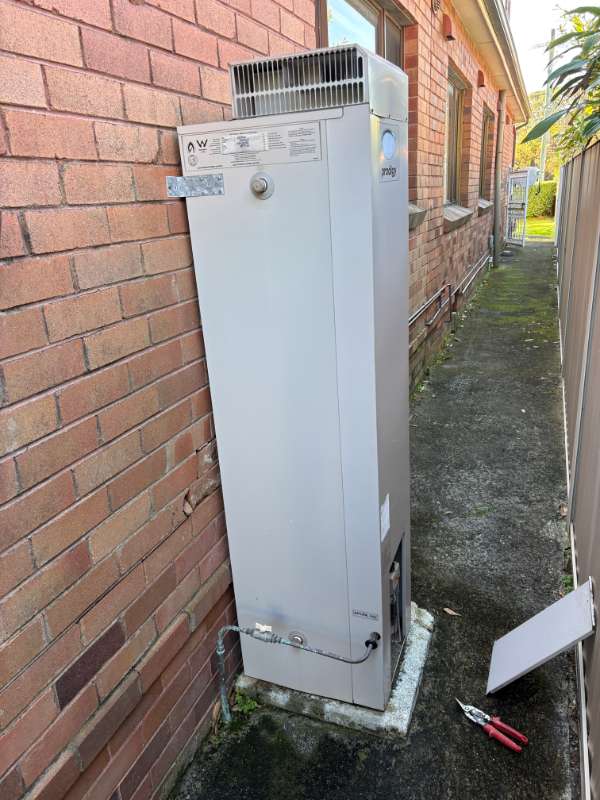
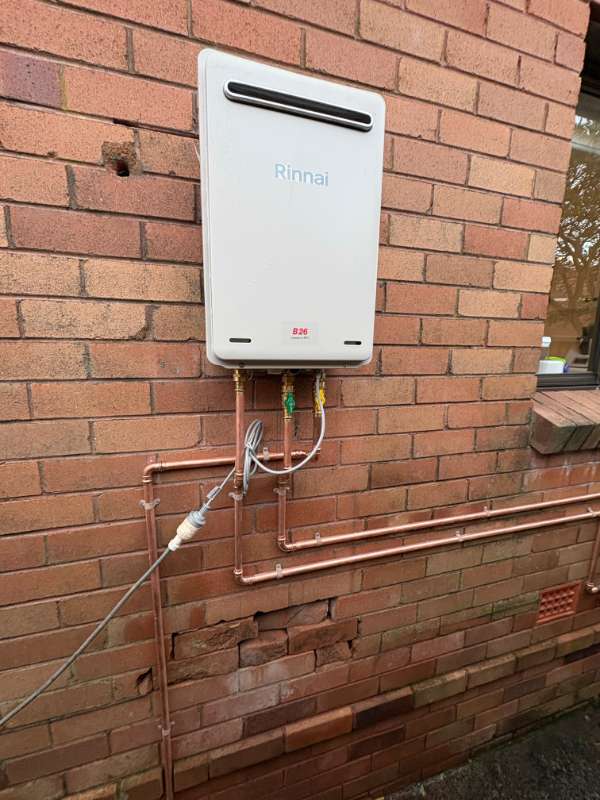
Here's a recent gas hot water job nearby in Maroubra.
Old gas tank swapped for continuous flow, Maroubra (nearby)
The problem: the gas storage tank down the side of a Maroubra home had stopped delivering hot water.
What we did: we went through repair against replacement with the owners and the systems that would suit, and they chose a Rinnai continuous flow unit. We took out the old tank, mounted the new unit on the wall, increased the size of the copper pipework, and fitted a new gas regulator at the meter to give the unit the supply it needs.
The result: reliable hot water at every tap, on a gas supply sized for the new unit.
More local work is on our recent projects page.
“Great plumber, fixed my leaking taps quickly and at a great price!”
Tom (Google review)
Gas across Botany, area by area
- Either side of Botany Road: the oldest cottages, semis and terraces, with layered gas systems and capped branches.
- Around St Matthew's and the older streets: heritage homes where new lines need to be run neatly and discreetly.
- Towards the bay and Sir Joseph Banks Park: salt air on outdoor pipework, meters and BBQ points.
- The Mascot and Pagewood sides: post-war brick homes with gas hot water down the side.
- Newer townhouses and apartments: continuous flow units, grouped meters and compact kitchens.
Gas in heritage cottages and terraces
Botany has a long history, and some of its older streets have homes that owners want to keep looking original. Gas work in these homes is best done quietly: lines run under the floor rather than across a facade, meters left where they are unless they have to move, and new pipe kept out of sight where the rules allow. If your home is in a heritage area or you'd simply like to keep the street front untouched, tell us and we'll plan the route with that in mind.
Going all-electric?
Some Botany owners are replacing gas cooktops with induction, gas heaters with reverse-cycle air conditioning, and gas hot water with a heat pump. If that's your plan, we can tell you which appliances can stay for now and how to cap off the rest safely. When the last appliance comes off, the line should be capped and tested, and you'll need to talk to your retailer and Jemena about the meter. We'll explain what each option involves without pushing you either way.
Running gas to the back of a terrace
Terraces and narrow semis are a particular challenge. The meter is at the front, often by the front fence or in a recess beside the door, and the kitchen is at the very back of the house, sometimes 15 or 20 metres away. A new cooktop or continuous flow unit at the back needs a line that's big enough over that distance, and there may be no side passage to run it along. The options are usually under the floor, if there's enough clearance, or through the ceiling space. We work out which route is safe, compliant and least disruptive, and price it before we start. If the old line is too small, we'll explain whether it can be upsized in part or needs replacing all the way from the meter.
Questions to ask any gasfitter
- Are you licensed for gasfitting? Our licence is 398171C, and you can check it with Service NSW.
- Will you pressure test the whole system?
- Will I get a Certificate of Compliance?
- Is the price fixed, and what does it include?
- What warranty comes with the work? We give a lifetime labour warranty on our workmanship.
Looking after gas appliances
- Service gas heaters every year or two, before winter.
- Keep cooktop burners clean so the flame stays even.
- Check the hose behind a freestanding oven when you clean behind it.
- Keep the meter and hot water unit clear of plants and stored gear.
- Fit a carbon monoxide alarm if you use a gas heater indoors.
Gas words explained
- Bayonet: a quick-connect socket for a portable gas heater.
- Regulator: the device at the meter that sets the gas pressure.
- Pressure test: a test showing whether the system holds pressure, which tells us if gas is escaping.
- Continuous flow: a hot water unit that heats water as it's used rather than storing it.
- Flue: the pipe carrying combustion gases outside.
- Certificate of Compliance: the paperwork recording the gas work and that it meets the rules.
Gas in apartments and townhouses: flues and balconies
In Botany's newer apartments and townhouses, gas appliances are squeezed into tight spaces. Continuous flow units are often mounted on a balcony wall or in a recess, and their flues need clearance from windows, doors and the balcony above. When a unit is replaced, the new one has to meet the same clearances, which isn't always possible in exactly the same spot. Cooktops in compact kitchens need the right distance to the rangehood and side walls. We check all of this before quoting, so the new appliance can be installed where you want it, or we'll tell you why it needs to move a little.
Gas or induction cooktop?
| Gas | Induction | |
|---|---|---|
| Cooking feel | Instant, visible flame; suits woks | Very fast and precise once you're used to it |
| Installation | Gas point and approved connection | A dedicated electrical circuit, usually by an electrician |
| Cookware | Works with anything | Needs pans that work on induction |
| Cleaning | Burners and trivets to clean | Flat glass surface |
| Ventilation | A rangehood is important | Still useful, less heat in the kitchen |
We install and service gas cooktops. If you're going induction, we can cap off the old gas point safely and leave the rest of your gas system as it is.
Buying or selling in Botany
Older Botany homes often change hands with gas systems nobody has looked at for years. A gas pressure test before you buy tells you whether the system is sound, and it's quick. If you're selling, having any known gas faults fixed and a Certificate of Compliance on file for recent work gives buyers one less thing to worry about.
Gas heaters in older Botany homes
Older cottages and terraces near the bay can be draughty and cold in winter, and a lot of them rely on a gas heater in the lounge. Before the cold sets in, it's worth checking a few things. Is the heater flued to the outside, or a portable plugged into a bayonet? Has it been serviced in the last couple of years? Are the room's vents clear, or have they been painted over or blocked during earlier work? Is there soot on the wall or ceiling above it? An annual service checks the burner, the safety cut-outs and the flue, and makes sure the heater burns cleanly. If the heater is very old, parts may not be available, and a new flued heater or a different kind of heating may be the safer choice. We'll tell you honestly what we find.
If you're installing a new flued wall heater, the flue has to go through an outside wall with the right clearances from windows, doors and the boundary. On a narrow terrace block, that can limit where the heater goes, so it's worth checking before you buy one.
Moving the gas meter
Sometimes a gas meter is in the way of a new driveway, fence, extension or side gate. The meter belongs to Jemena, so moving it has to be arranged with them, and your gasfitter then reconnects the pipework on your side to the new position. If you're planning work near the meter, talk to us early. We'll tell you what's involved and help you plan the timing so you're not left without gas longer than necessary.
What happens when you call
Tell us what's going on
Call or send a quick form. A photo of the problem helps us come prepared. No call-out fee.
Options and a fixed price first
We find the cause, explain your options and give you a fixed price for each before any work starts.
Fixed, tested and backed
We do the work, test it, clean up, and back our workmanship with a lifetime labour warranty.
Jobs we finished recently
Why Botany homeowners call us
- Based in Matraville, next door to Botany
- Rated 5.0 from 110 Google reviews
- Free quotes, with options and a fixed price before any work starts
- Lifetime labour warranty on our workmanship
- Licensed plumbers, drainers and gasfitters (Lic. 398171C)
Gas fitting questions from Botany homeowners
Do I need a licensed gasfitter to connect a cooktop?
Yes. In NSW gas work must be done by a licensed gasfitter and certified.
Why does my continuous flow hot water go cold when the cooktop is on?
The gas line or regulator is probably too small for both appliances at once. We can check and upgrade it.
Will my old gas line handle a new cooktop?
Often, but big wok burners need more gas. We check the pipe size and test the line first.
Can you move my gas bayonet?
Yes. We can move it, add another, or fit a point for a flued heater.
Can I connect my bottled-gas BBQ to the house gas?
Only after it's converted for natural gas. We can fit a fixed BBQ point and connect a natural gas barbecue.
Who fixes a leak at the gas meter?
Jemena. The meter and the street side belong to them. Anything on the house side is yours.
My cooktop flames are yellow. Is that a problem?
It means the gas isn't burning cleanly. Stop using that burner and have it checked.
Do you do gas work in Botany apartments and townhouses?
Yes, inside your own home. Shared supplies and meter banks belong to the owners together.
What's a Certificate of Compliance?
The paperwork that records the gas work and confirms it meets the standards. You get one for our gas work.
Can you cap off gas if I switch to a heat pump?
Yes. We cap and test the line so the system is left safe.
How long does a cooktop swap take?
A straight swap is usually a couple of hours. A new line takes longer.
Should I get a gas check before buying an older Botany cottage?
It's a good idea. A pressure test shows whether the system is sound before you move in.
More plumbing in Botany: our Botany plumber page, hot water, blocked drains, taps and toilets and water filters. Nearby: gas fitting in Pagewood and Matraville. Guides: gas fitting, gas compliance certificates and gas point installation.