Leak detection in Banksmeadow 2019 for industrial sites and homes
Banksmeadow's sandy, reclaimed ground hides water leaks well. A pipe can leak for months under a concrete yard and the water simply drains away into the sand, with no puddle to show for it. On a large site, the first sign is usually a water bill much bigger than the last one, or clean water running into a stormwater pit when it hasn't rained. We're based a few minutes away in Matraville, and we've found leaks as deep as 1.8 metres under the internal road of a factory complex on Beauchamp Road.
Leaks we find on Banksmeadow sites
Water mains under yards and roads
Leaks on the site's main water service under concrete, driveways and internal roads.
Fire service leaks
Leaks on fire hydrant and sprinkler pipework, often found when clean water turns up in a pit.
Under-slab leaks
Pipes leaking under the floor slab of a factory, office or home.
Leaks in walls and ceilings
Pipes in amenities and offices leaking into walls, ceilings and the unit below.
Running toilets and urinals
Constant flow from amenities toilets and urinals, the most common cause of a high bill.
Leaks at the meter and boundary
Leaking meter assemblies, backflow devices and valves at the boundary.
Signs of a hidden leak
- A water bill much higher than usual, without a change in how the site is used.
- The meter moving when everything on site is turned off.
- Clean water running into a stormwater pit in dry weather.
- Damp or soft ground, or a patch of grass that's greener than the rest.
- Water coming up through cracks in concrete or the road surface.
- Low water pressure across the site.
- Damp walls, stains or mould in amenities, offices or a home.
- The sound of running water when nothing is on.
Why leaks hide in Banksmeadow
Sand swallows the water
On clay ground, a leak usually comes to the surface. On Banksmeadow's sand, the water drains straight down and away. A pipe under a yard can lose a lot of water every day with nothing to see on top, and only the meter or the bill tells the story.
Long services on big sites
An industrial site's water service can run a long way from the meter to the buildings, branching to each unit, the amenities, hose taps and the fire service. The longer the pipe, the more joints there are to leak and the harder the leak is to find without the right equipment.
Old pipe materials
Older sites can still have cast iron, galvanised steel or early copper underground. Cast iron cracks, galvanised rusts from the inside, and copper can be damaged by ground movement or corrosive soil. When an old main fails, it can fail suddenly.
Heavy traffic and ground movement
Trucks and heavy equipment driving over a shallow pipe, and the settling of sandy ground, put stress on joints and fittings. Pipes in rock or rubble trenches can be rubbed through over time.
Banksmeadow sites and their leaks
| Type of site | Where leaks hide | How we find them |
|---|---|---|
| Factory complexes | Main service under the internal road, branches to each unit | Meter test, tracer gas, acoustic listening |
| Large warehouses | Long underground mains, fire services, yard hose taps | Isolation testing section by section, tracer gas |
| Workshops and offices | Under slab, in walls, amenities | Thermal camera, pressure testing, moisture meter |
| Sites with fire services | Hydrant and sprinkler lines | Pressure testing, tracing where clean water enters pits |
| Homes near Botany | Front yard service, under floors, in walls | Meter test, thermal camera, acoustic listening |
How we find a leak
- Confirm the leak. With everything off, we read the meter, then read it again. If it moves, there's a leak on the site's side.
- Narrow it down. We turn off branches, units and services one by one to find which section is leaking.
- Pinpoint it. Tracer gas is fed into the pipe and rises through the ground where the pipe is broken. Acoustic listening picks up the sound of escaping water. A thermal camera shows hot water leaks in walls and floors.
- Give you options. We explain where the leak is and give you options with a fixed price for each: repair the section, or bypass it with a new line.
- Repair and test. We fix the leak, turn the water back on, and confirm the meter has stopped moving.
A recent job nearby
Here's a recent leak job at a factory complex on Beauchamp Road in Matraville, just up the road from Banksmeadow.
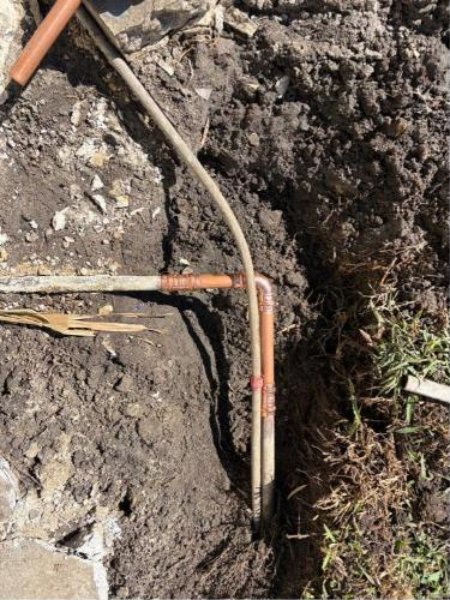
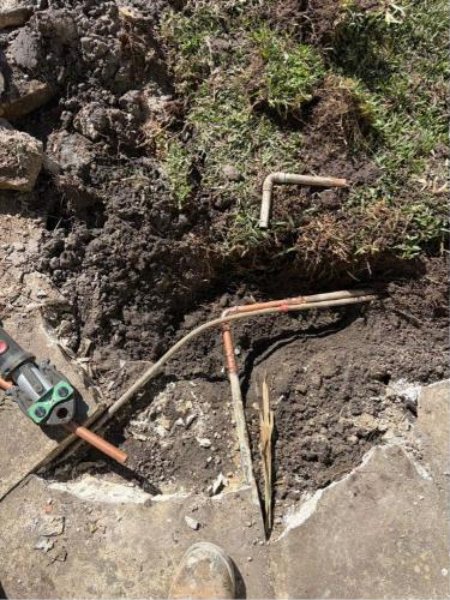
Leaking 100 mm water main found 1.8 m under the road, factory complex, Matraville (nearby)
The problem: water was coming up through the internal road of a factory complex on Beauchamp Road, Matraville. The pipe ran through a rock trench, so the leak could have been anywhere along it.
What we did: we brought a five-person crew, a 5-tonne excavator and a tipper, and isolated the supply over a weekend. We dug in three places, then used tracer gas and a leak detector to pinpoint the break: a cracked 100 mm cast iron pipe about 1.8 metres down. The crack was too big for a repair band, so we cut out the damaged section and fitted a new length of pipe, then backfilled with clean sand and new fill.
The result: the water was back on before the businesses opened on Monday, and the meter showed no movement once everything was turned on, so there were no other leaks.
More local work is on our recent projects page.
Quick fix or long-term fix?
| Problem | Quick fix | Long-term fix |
|---|---|---|
| Leak on an old main under a yard | Repair the broken section | Replace or bypass the old main with new pipe |
| Several leaks on galvanised pipe | Repair each leak | Replace the galvanised section |
| Running toilets and urinals | Replace the worn valve | Service all amenities fixtures and check them each year |
| Leak under a slab | Repair under the slab | Reroute the pipe through a wall or ceiling |
| Fire service leak | Repair the section | Replace corroded fire service pipework |
What affects the cost
- How long it takes to find the leak, which depends on the size of the site.
- How deep and where the pipe is: under concrete, roads, rock or in a building.
- Equipment: tracer gas, excavators, concrete saws and pumps.
- Timing: working on a weekend or outside business hours so water can be off.
- Making good: concrete, asphalt, paving or walls.
You get a fixed price for each option before any work starts.
Who's responsible?
- The site owner: the water pipes on the property after the meter. In a lease, check who pays for repairs.
- Factory complexes: the main service under shared roads is usually the complex's; pipes inside a unit belong to that unit.
- Sydney Water: the water main in the street and the meter itself. If the leak is on their side, we'll tell you who to call.
- Fire services: owned by the property owner, but tested and maintained under fire safety requirements.
Quick checks you can do
- Turn off every tap and fixture on site and read the meter. Wait an hour without using water and read it again.
- Walk the amenities and listen for toilets or urinals running.
- Check stormwater pits in dry weather for clean water running in.
- Look for damp patches, soft ground or water coming up through cracks.
- Compare this bill with the same time last year.
Signs it's urgent and when it can wait
- Call straight away if water is coming up through the ground or road, flooding a building, or near electrics.
- Call soon if the meter is moving fast, or your bill has jumped.
- Book a time if the meter is creeping slowly or you want the site checked before a lease starts.
Water bills on big sites
On a large site, a small leak can cost more than you'd think. A running urinal or a toilet that never stops filling can waste a lot of water every day, and a leaking main under the yard can waste far more. Sydney Water bills are based on the meter, so you pay for every litre whether it was used or lost. If your bill has jumped, a meter test is the quickest way to know whether you have a leak or a change in use.
Tracer gas, explained
Tracer gas is a harmless mix of hydrogen and nitrogen. With the water drained or at low pressure, we feed it into the pipe. Hydrogen is the smallest molecule there is, so it escapes through even a tiny crack and rises through soil, sand and concrete. A sensitive detector picks it up at the surface right above the break. On the Beauchamp Road job, the leak was 1.8 metres down in a rock trench, and tracer gas pinpointed it after test holes in three places had not.
Thermal imaging
We own a thermal camera. A hot water leak in a wall, ceiling or slab warms the surface around it, and the camera shows that as a warm patch, so we can find the leak without opening up walls or floors to look. It works best for hot water pipes and in buildings rather than deep underground.
Leaks on fire services
Fire hydrant and sprinkler pipework holds water at pressure all the time. When it leaks underground, the water often finds its way into nearby stormwater pits, which is how we spotted a likely fire service leak at the Beauchamp Road complex while cleaning a pit. Fire services also need the right backflow device and regular testing, so a leak is worth finding and fixing properly.
Banksmeadow, area by area
- Industrial estates off Botany Road: factory complexes with long shared mains under internal roads.
- Larger warehouses and terminals: long underground services, fire services and yard hose taps.
- Near the port and the bay: reclaimed sandy ground where leaks drain away unseen.
- The Botany side: homes and units with older front-yard water services.
- Next door in Botany, Hillsdale and Matraville: the same sandy ground and the same hidden leaks.
Leak detection words explained
- Meter test: reading the meter with everything off to check for a leak.
- Isolation test: turning off sections of pipe one at a time to find which one leaks.
- Acoustic listening: using sensitive microphones to hear water escaping from a pipe.
- Tracer gas: a harmless gas fed into the pipe that rises at the leak.
- Thermal camera: a camera that shows heat, useful for hot water leaks.
- Bypass: running a new pipe around a leaking section instead of digging it up.
Homes in Banksmeadow
For the homes and units on the Botany side of Banksmeadow, we find leaks in front-yard water services, under floors, in walls and in showers, just as we do in Botany. If your bill has gone up, start with a meter test. See leak detection in Botany.
Finding a leak on a large site, step by step
- We read the meter with the site closed and note how fast it moves.
- We find every valve on the site and draw up a simple map of the service.
- Sections are turned off one at a time while we watch the meter.
- Once the leaking section is found, we use tracer gas or acoustic listening along it.
- We mark the leak, and give you options and a fixed price to repair it.
- After the repair, we read the meter again to confirm there are no more leaks.
Before you lease or buy a site
A hidden leak can come with a site. Before you sign, it's worth a meter test and a quick check of the amenities and visible pipework. We can tell you whether there's a leak, roughly where, and what it would take to fix, so it can be sorted before you take over the bills.
Leaks in staff amenities
On most sites the biggest everyday water waste isn't underground at all. It's in the amenities. A toilet inlet valve that doesn't quite close sends a thin stream into the bowl all day and all night. A urinal flushing system stuck on, a leaking flush valve, or a basin tap that drips into a sink nobody looks at all add up. Because the water goes quietly down the drain, nobody notices. At one Beauchamp Road factory unit, a tenant had wedged a piece of timber in a cistern to hold the float up rather than have it fixed. We walk the amenities on every leak job, listen and look at every fixture, and fix what's wasting water.
The food colouring test for toilets
Put a few drops of food colouring in a toilet cistern and don't flush for half an hour. If colour appears in the bowl, the outlet valve is leaking. Do it on every toilet in the amenities. It costs nothing, and it often explains a bill that has crept up over a few months.
When the water can't go off
Finding a leak on a big site often means turning sections of the water service off to see which one is leaking, and repairing it means turning the water off completely. For a business, that's a cost in itself. We plan around it: tests early in the morning before staff arrive, repairs on a Saturday or Sunday, and temporary connections where a section has to stay live. On the Beauchamp Road job, the water was off over a weekend and back on before the businesses opened on Monday.
Why the meter matters
Your water meter is the best leak detector on the site. If everything is off and the meter is still turning, water is going somewhere. Make a note of where your meter is, read it at the same time each week, and you'll spot a leak long before the bill arrives. On some meters there's a small red or black dial that spins with even a tiny flow, which makes slow leaks easy to see.
Repair or replace an old main?
When we find a leak on an old cast iron or galvanised main, the question is whether to fix the one break or replace the line. A single repair is quicker and cheaper today. But if the pipe is old and the ground has already broken it once, more leaks are likely. We'll show you what the pipe looked like where we opened it, and give you a fixed price for both options so you can decide with the facts in front of you.
What to tell us when you call
- Where the water meter is and whether it's moving with everything off.
- How big the jump in the bill was, and over what period.
- Whether you've seen water anywhere: in pits, through cracks, in walls or ceilings.
- Whether the site has a fire service and where its valves are.
- When the water could be turned off for testing or repairs.
With that, we can bring the right equipment on the first visit, and on a big site we'll often start with a meter test early in the morning before staff start using water.
Leaks between units
In a factory complex, units share walls and sometimes share pipes in ceilings and under floors. Water from a leaking pipe in one unit can show up in the next. We find which unit the leak belongs to, fix it, and give each side a short note with photos so there's no argument about who pays.
Hose taps and wash areas
Hose taps on yards and loading docks get knocked, left running and frozen open by worn washers. Wash areas have hoses, spray guns and solenoid valves that can stick. Because they're outside and often near a drain, a leak there just runs away. We check every hose tap and wash point on a leak visit, replace worn taps with heavier ones that suit an industrial yard, and fit vacuum breakers where they're needed to protect the water supply.
What happens when you call
Tell us what's going on
Call or send a quick form. A photo of the problem helps us come prepared. No call-out fee.
Options and a fixed price first
We find the cause, explain your options and give you a fixed price for each before any work starts.
Fixed, tested and backed
We do the work, test it, clean up, and back our workmanship with a lifetime labour warranty.
Jobs we finished recently
Why Banksmeadow businesses and homeowners call us
- Based in Matraville, a few minutes from Banksmeadow
- Weekend and early starts when that keeps your site running
- Rated 5.0 from 110 Google reviews
- Options and a fixed price before any work starts
- Lifetime labour warranty on our workmanship
- Licensed plumbers, drainers and gasfitters (Lic. 398171C), with accredited backflow testers on the team
Leak detection questions from Banksmeadow businesses and homeowners
Can you find leaks on big industrial sites?
Yes. We test section by section to narrow it down, then pinpoint the leak with tracer gas, acoustic listening or a thermal camera.
Our water bill has jumped. Where do we start?
With a meter test: everything off, read the meter, wait, read it again. If it moves, there's a leak. We can do it for you.
Can you find a leak under concrete without digging it all up?
Yes. We pinpoint the leak first, so we only open up the spot where it is.
Can you come today?
We offer same-day service. Tell us if water is coming up through the ground when you call.
Can you work on a weekend?
Yes. If the water needs to go off across the site, we can do the repair on a weekend so it's back on for Monday.
There's clean water in our stormwater pit. Is that a leak?
In dry weather, often yes, from a water or fire service pipe nearby. We can trace it.
Do you have a thermal camera?
Yes. We use it to find hot water leaks in walls, ceilings and slabs.
Who pays for a leak in a factory complex?
Leaks on shared mains are usually the complex's; leaks inside a unit belong to that unit. We'll tell you where it was.
Is a leak on Sydney Water's side my problem?
No. If the leak is on the street main or the meter, we'll tell you so you can report it to Sydney Water.
Can you give us a report for an insurer or owner?
Yes. We give you a short report with photos of what we found and fixed.
Do you still look after homes in Banksmeadow?
Yes. We find leaks for the homes and units on the Botany side of Banksmeadow too.
Do you give a fixed price?
Yes, for each option, before any work starts.
More plumbing in Banksmeadow: our Banksmeadow plumber page, burst pipes, stormwater and backflow testing. Nearby: leak detection in Botany and Hillsdale. Guides: hidden water leak guide, water meter guide and hearing water running.